
200 Economists Warn AI's Economic Impact Outpaces Industrial Revolution
TL;DR
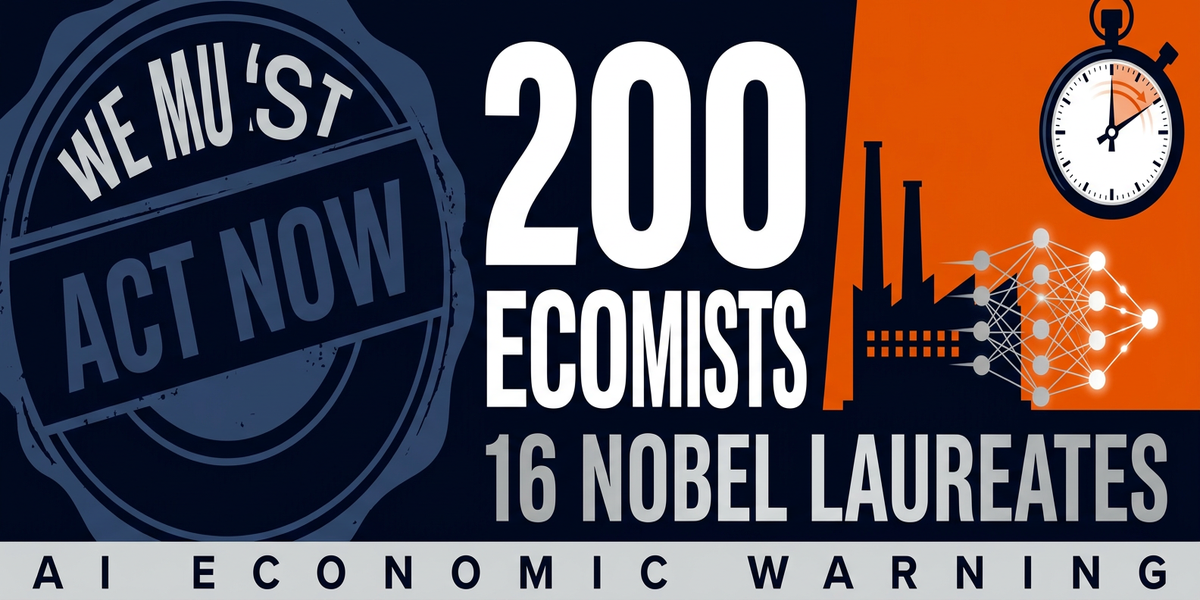
- 200+ economists and 16 Nobel laureates put their names on a Stanford-organized statement July 13, 2026. The warning? AI's gonna hit the economy harder and faster than anything before it. - Big names on the list: notable economists and researchers from leading institutions. - Steam power bought societies decades. Electricity too. AI might give us years. That's the whole pitch. - The statement demands proactive policy but offers no specific recommendations. So if you're sitting around waiting for institutional guidance, you're gonna wait past the point where it helps.
What does the statement actually claim?
Honestly, the core claim isn't complicated. AI could trigger an economic shift bigger than the Industrial Revolution, packed into a fraction of the timeline.
Here's how they build the argument.
General-purpose technologies — steam, electricity, computing — gave people decades. Decades to retrain workers. Decades to build institutions. Decades to figure out who gets what. The statement says AI compresses that adaptation window down to a handful of years. Not a generation. A few years.
Organized by Stanford's Digital Economy Lab and released July 13, 2026, the document carries the title "We Must Act Now: A Statement on AI's Transformation of the Economy." Stanford frames it as a wake-up call for economists, policymakers. And technology leaders to get ahead of this rather than scrambling when things break.
The announcement specifically calls for more research into AI's economic effects and for building policies and institutions that make sure AI complements human capabilities instead of replacing them.
But here's what struck me.
More than 200 researchers from top universities and AI labs worldwide signed a document that uses phrases like "urgent preparation" and "radically more powerful AI." That's not normal academic language. Economics as a field runs on caution, on hedged claims, on statistical significance. When a profession built on that kind of restraint puts out something this blunt? The tone is doing as much work as the content.
Why do these particular signatures matter?
The signatory list is the real story here.
Not the statement text.
The signatories include respected economists and researchers. These aren't podcast futurists or VC-funded think tank fellows. Their entire careers are built on rigorous empirical work studying how technology and labor markets interact.
Then you've got the insiders from major AI organizations. These are people actively building frontier AI systems. Signing a letter that says the economic fallout from their own work demands urgent preparation.
When the builders and the outside critics agree on the timeline, that convergence is the headline.
The organizers behind this: a group of leading economists. They pulled together a coalition that spans academia and the labs themselves.
When the people who understand AI best.
Both the ones making it and the ones studying its effects. Land on the same page about urgency, the gap between what's being built and what society is ready for becomes the actual story.
That gap is where every small operator already lives.
What should small operators actually do?
If you're already running an AI-augmented operation, this statement is a receipt.
Not a surprise.
My agency tracks commit attribution on every deliverable. We price based on how much AI accelerates production. So the compression these economists are modeling? We see it in our invoices. In client requests.
In how weekly workflows shift quarter to quarter.
Here's the practical reality for a solo operator or small business owner.
Stop waiting for policy. Congress moves on election cycles. Regulatory agencies move on bureaucratic cycles. Universities move on academic years. AI capability moves on model release schedules — every few months, sometimes faster.
Those clocks don't sync. The gap between institutional timelines and capability timelines is where small operators either pull ahead or get left behind.
So what does "prepare in advance" mean if you're running a lean operation? Concrete stuff. Audit your services for AI automation risk. If a model that shipped last quarter can handle a task you charge premium rates for, reprice it now. Don't wait. Build a service portfolio assuming your workflow changes every six months, not every six years. The economists just told you. In a signed letter with their real names attached. That the adaptation window is years, not decades.
Your business plan should reflect that. Or it's built on assumptions the people who understand this stuff best just told you are wrong.
Where does the statement fall flat?
200 economists. 16 Nobel laureates. One urgent warning about AI's economic impact.
Number of concrete policy recommendations in the statement: none.
Stanford calls for "building the policies and institutions needed." Which policies?
Which institutions? The document doesn't go there.
Honestly? That silence is the most useful thing about it.
If the combined brainpower of the world's leading economists and frontier AI researchers can't produce a single specific policy proposal, institutional protection isn't coming fast enough to help you. The statement says prepare rather than improvise. For a solo operator, you ARE the institution. Your calls on AI adoption, pricing, hiring, skill development. That's the policy response that actually shows up on time.
The economists confirmed the scale and speed today.
July 13, 2026. What happens next is yours to build.
If you're running lean and want to end up on the right side of what these 200 researchers are describing, start with your own workflow. Which tasks could a current model handle by end of quarter? Which ones genuinely need human judgment that AI can't touch yet? Price the first category down. Double down on the second.
Window's open. But the people who signed that letter just told you it won't stay open long.
Sources
- Stanford Digital Economy Lab: "We Must Act Now" - Global Banking and Finance: Over 200 Experts Call for Urgent Action on AI's Economic Impact - El Destape Web: Nobel Laureates Among 200+ Experts Urging Action on AI
Comments ()