
AgentWorld Grades Multi-Agent LLM Teamwork in a 2D RPG
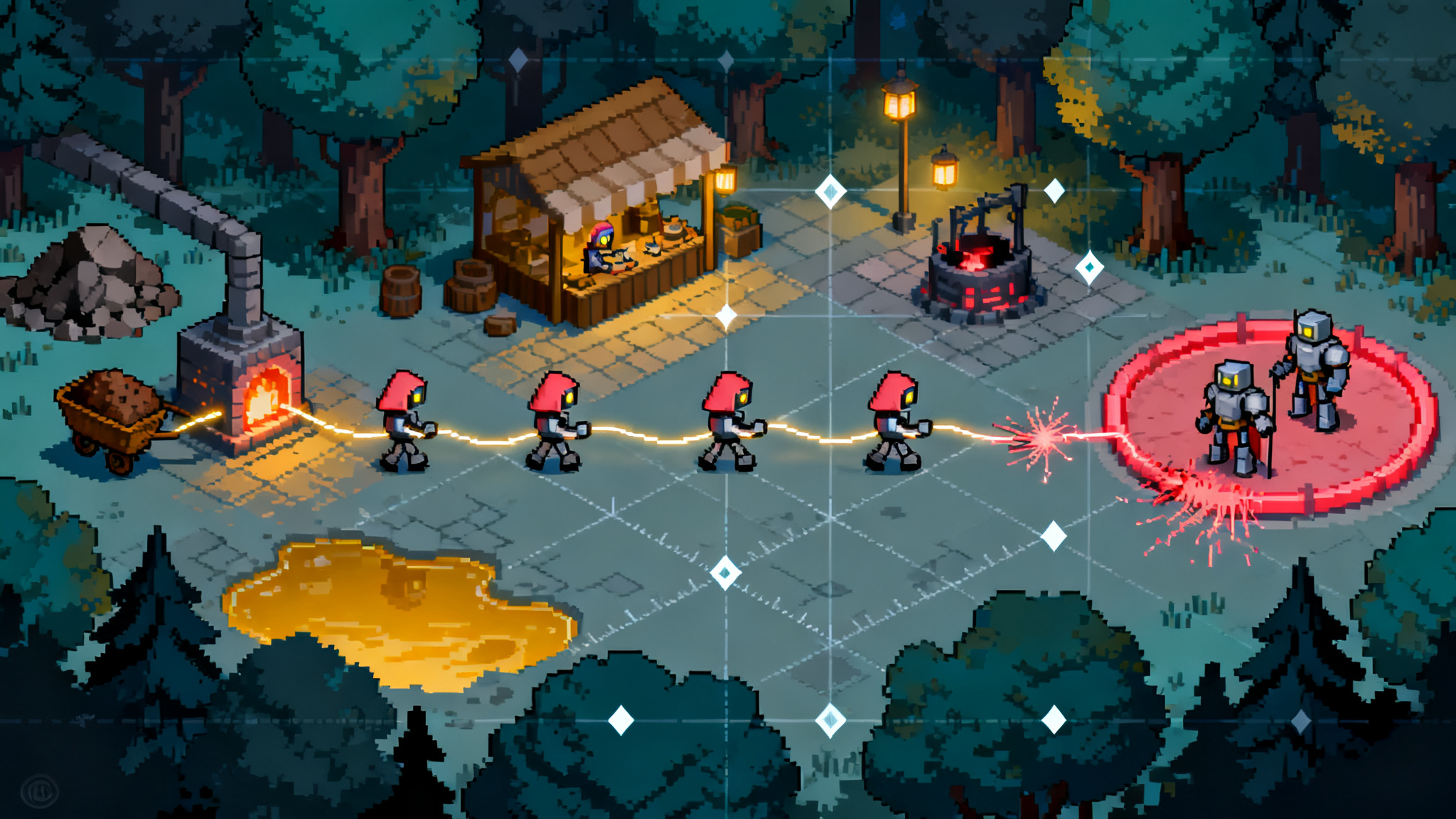
AgentWorld grades multi-agent LLM teamwork inside a persistent 2D RPG. And that framing fixes a real gap in how agents get evaluated. AgentWorld is an open-source research platform built on the Kaetram game engine, designed to study multi-agent coordination in a persistent 2D multiplayer environment (project page). Agents connect through a REST API or an MCP interface, share one world, form parties, negotiate strategies, trade resources, and complete tasks together. The research listing names the work "AgentWorld: Benchmarking Long-Horizon Collaboration of Multi-agent LLMs," which tells you the target: sustained, long-horizon teamwork, not single-model leaderboard points (research listing). It supports agents built with Claude, GPT, Gemini, DeepSeek. And other providers, so mixed-model parties are part of the design from day one.
What AgentWorld Actually Measures
Most agent benchmarks put one model in a room and score it alone. AgentWorld puts several in the same room and scores what happens between them.
The platform provides a unified API covering both observations and actions. And the world stays persistent, so decisions compound instead of resetting every task.
The intended task classes are crafting, trading, and combat. Those sound like game flavor, but each one pressures a different coordination skill. Crafting forces dependency management, because complex outputs need inputs somebody else is holding. Trading forces negotiation. Combat forces role assignment under pressure.
A benchmark that requires all three is measuring something a solo quiz never touches.
The research team behind the listing includes Raphael Shu, Yusen Zhang, Zhou Yu, Lyle Ungar.
And Rui Zhang, among others. Their stated aim is moving evaluation from isolated LLM benchmarking to dynamic, multi-agent behavioral research, including both collaboration and competition in resource-constrained environments. That last phrase matters.
Scarcity is what makes cooperation expensive. And it is also the normal operating condition for any real automation stack running against a budget.
Why Long-Horizon Collaboration Breaks First
The AgentWorld description is blunt about what success requires: agents have to communicate with one another, coordinate roles.
And adapt to other agents' behavior.
Read that as a failure list. Communication fails when handoff context gets truncated. Role coordination fails when two agents claim the same job. Adaptation fails when one agent's output quietly invalidates another's assumptions.
This maps directly onto what I see building multi-agent automations for small businesses.
The pipelines that break are rarely broken by a dumb model.
They break at the seams: duplicated work, contradictory instructions passed downstream, one agent undoing another's changes three steps later.
Single-agent benchmarks are structurally blind to all of it, given that there is no seam to fail at.
The long-horizon part is the multiplier.
Sustained teamwork is named as the central evaluation target for AgentWorld.
And the same research agenda contrasts it with a sibling project, Chain of Agents, which attacks joint reasoning over inputs too large for a single context window. Those are the two axes that actually limit agent systems in production: breadth, when the input outgrows the window. And duration, when the task outgrows the model's ability to stay coherent. AgentWorld is aiming squarely at duration. That is the axis my clients feel, as a workflow that drifts after twenty minutes is worthless no matter how smart its components tested in isolation.
Do Not Confuse It With Qwen-AgentWorld
Search for "AgentWorld" right now and you will hit a name collision that deserves a warning label. Qwen-AgentWorld is a separate project, described as a language world model for general agents (paper). It ships models named Qwen-AgentWorld-35B-A3B and Qwen-AgentWorld-397B-A17B, which the paper describes as language world models simulating agentic environments across seven domains: MCP, Search, Terminal, SWE, Android, Web, and OS (repo).
The two projects point in opposite directions. AgentWorld puts real agents into a real shared world and watches them interact. Qwen-AgentWorld trains a model to be the world: it predicts the next environment state given an agent's action and interaction history (model card). It was built through a three-stage pipeline of continued pretraining, supervised fine-tuning. And reinforcement learning, with environment modeling as the training objective from the continued-pretraining stage onward rather than a bolt-on.
Both directions are legitimate research.
Just know which one you are reading before you quote it, since conclusions from one do not transfer to the other.
A model that simulates environments tells you nothing about how two live agents negotiate over scarce resources.
And a sandbox full of live agents tells you nothing about simulation fidelity.
What This Means for Small Operators
If you sell or run multi-agent automation, the question this benchmark family is forcing into the open is the one that decides your margins: does adding a second agent improve outcomes, or does it multiply failure modes? Buyers are getting smarter about this fast. The pitch "we orchestrate multiple agents" is already commoditized. The defensible claim is that your agents coordinate over long horizons without a human babysitting the handoffs. And platforms like AgentWorld are how that claim gets tested instead of asserted.
The practical entry cost is low, and that is the part small teams should notice. AgentWorld is fully open source, and agents connect through a REST API or an MCP interface. If your stack already speaks MCP, pointing your existing agents at a shared sandbox is a weekend experiment, not a procurement project. Run your current model mix through it and watch where coordination degrades. That output is more useful than another round of single-model evals.
My contrarian caution: a 2D RPG is a clean world with crisp rules, and production is neither. Treat results from it as directional evidence about coordination behavior, not as a certification. A party of agents that trades well in Kaetram still needs supervision when the "resources" are a client's CRM records and the "combat" is a refund dispute.
What To Do Next
Go read the AgentWorld research listing and the platform description, then audit your own agent handoffs this week.
Find every place two agents touch the same task or the same data. And ask what happens when their outputs disagree. That exercise costs an afternoon and will surface more real risk than any single-agent benchmark score.
And if you have a multi-agent build that drifts on long runs, that is exactly the work I do: small-business automation that survives its own coordination.
Get in touch and we will find the seam that keeps splitting open.
Comments ()