
Anthropic Just Blocked OpenClaw From Claude Code Subscriptions. Users Are Calling It a Bad Path.
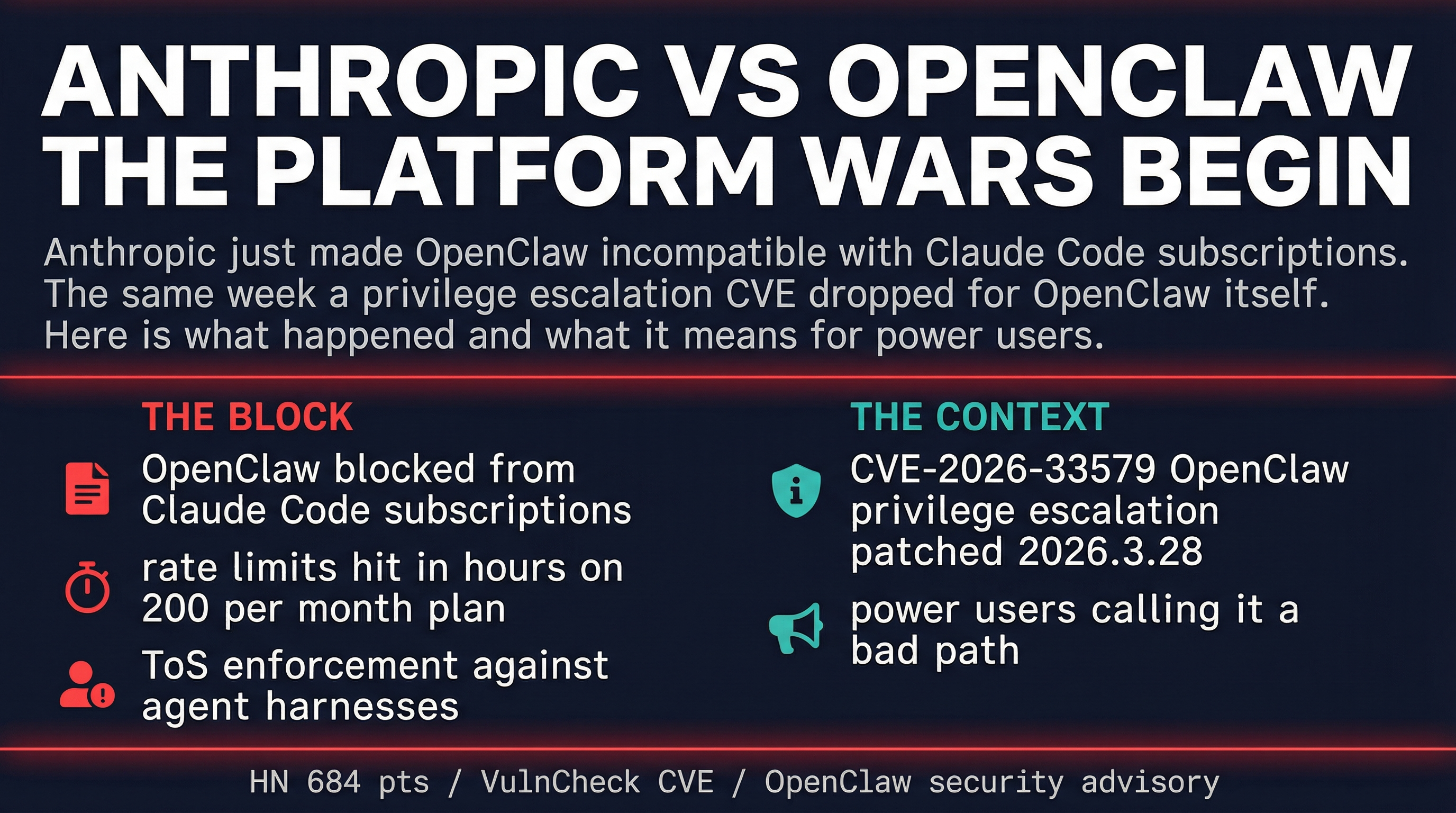
Anthropic is now explicitly blocking Claude Code subscription plans from working with OpenClaw. If you have been running OpenClaw as a harness for Claude Code, your subscription access is no longer welcome there.
This dropped on HN Friday and went straight to #1. 684 points. 563 comments and counting. The timing caught people's attention for a specific reason: the same day Anthropic moved to restrict OpenClaw access, a security vulnerability disclosure dropped for OpenClaw itself. CVE-2026-33579, a privilege escalation in device pair approval, patched in version 2026.3.28. Anthropic's terms update and an OpenClaw CVE landing on the same day made the whole thing feel coordinated.
What Actually Happened
OpenClaw routes CLI sessions through Claude Code's API. That is how it works. Anthropic looked at that architecture and decided it violates the subscription model. The terms now say Claude Code subscription plans cannot be used to power third-party agent frameworks.
The business logic behind this is not mysterious. OpenClaw acting as an autonomous power user consumes significantly more than a human subscriber. Reports in the HN thread put the multiplier at 6 to 8 times. A single OpenClaw session can burn through what a human user would use in an entire month. Anthropic is between two bad options: raise subscription prices or restrict how subscriptions get used. They chose the restriction.
Users are not handling it well. The $200 per year plan gets described as a burst plan, not an unlimited plan. People on $200 per month plans report hitting rate limits after just a few hours of use. Some got banned entirely for running multiple consecutive usage windows, which the terms apparently flag as a violation even though nobody reads the terms closely enough to know that.
The Rate Limit Reality
Here is what subscribers are saying in the thread. The limits are not theoretical. You can hit them fast if you are actually using the product. One commenter described being on the $200 per month plan and finding that their Claude Code sessions would start returning rate limit errors after a few hours of active work. Another said they downgraded to the $20 plan expecting worse problems and found the limits were similar.
The irony is that the people most likely to hit rate limits are the power users Anthropic wants to keep. If you are running autonomous coding sessions, doing long multi-step tasks, or using tools like OpenClaw that chain multiple operations together, you are going to hit the ceiling faster than someone doing occasional interactive queries.
API access exists as a separate purchase. But API access does not integrate cleanly with Claude Code because of context window restrictions. You cannot just buy API credits and have your Claude Code subscription work smoothly. They are separate systems with different behaviors.
Why This Matters for the Agentic AI Space
OpenClaw is not a tiny project. It is a legitimate agent framework that runs real workflows for real users. The fact that Anthropic is willing to restrict access to it tells you something about how seriously they are treating the margins on Claude Code subscriptions.
The comparison that showed up in the HN thread is instructive. One commenter described it as sushi buffet mentality. You pay a flat fee and eat as much as you want. But if you sit down with a group of friends and order 40 plates of otoro, the restaurant is going to ask you to leave. The flat rate only works if most people do not actually use it fully.
OpenClaw users are the 40-plate group. They found a way to use the flat rate more fully than the business model intended, and Anthropic just changed the rules.
The thing that should concern subscribers more than the policy change is the direction. If Anthropic is willing to restrict OpenClaw today, what happens when the next tool or workflow does not fit neatly into their terms? Platform lock-in is real when your workflows depend on a service that can change its ToS overnight.
Local LLM alternatives are getting better. That keeps coming up in these discussions. Gemma 4 posts benchmark numbers that sit at the top of leaderboards. Qwen models run on hardware that developers already own. The window where Anthropic has enough of a capability lead to dictate terms is not infinitely wide.
If you have built workflows around Claude Code and OpenClaw, start thinking about what the backup plan looks like. The terms changed. The limits are real. The vulnerability that dropped the same day is patched, but the restriction is a separate problem that is not going away.
Sources: - Hacker News Discussion - CVE-2026-33579 (NVD) - OpenClaw Security Advisory (GitHub)