
Apple OpenAI Trade Secret Suit Targets Two Defecting Engineers
Key Takeaways
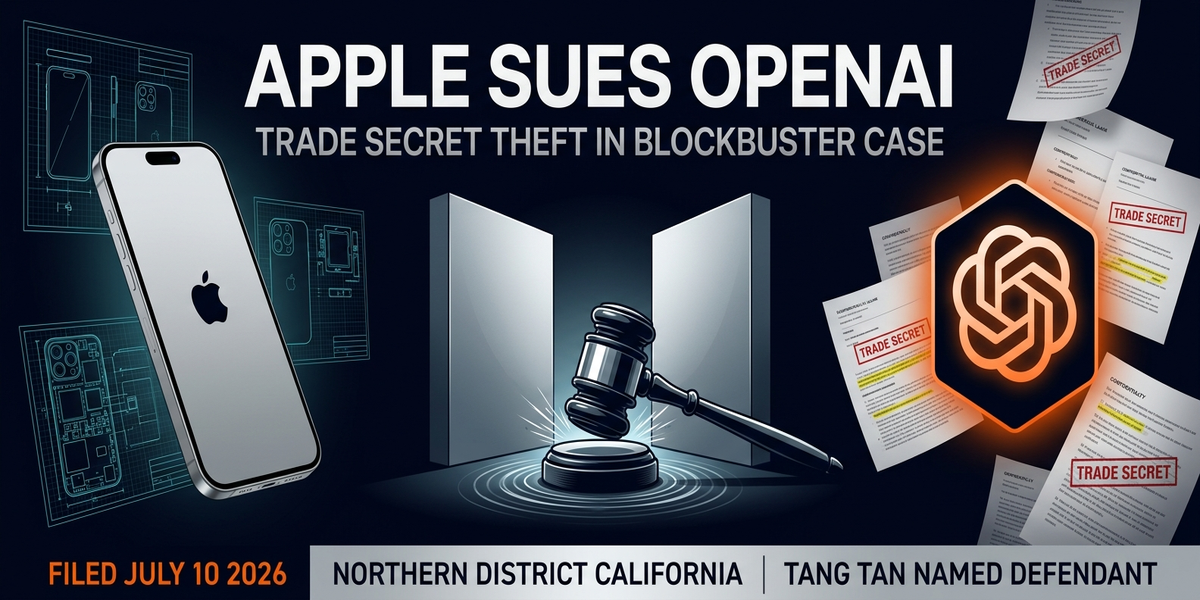
- Apple filed a "blockbuster" trade-secret lawsuit against OpenAI on July 10, 2026, in the Northern District of California, accusing the AI company of a "deliberate and systematic" theft of proprietary hardware designs. - Two former Apple employees are named: Tang Tan (ex–VP of product design for iPhone and Apple Watch, now OpenAI's Chief Hardware Officer) and Chang Liu (former senior system electrical engineer). - Apple claims both men took confidential design documents and engineering specs and handed them to OpenAI "for the benefit of OpenAI." - OpenAI acquired Jony Ive's hardware company io for $6.5 billion. And Apple says the people running that hardware push brought stolen blueprints with them. - This case is a wake-up call for any business: if Apple's legendary secrecy apparatus couldn't stop this, your IP protections probably have gaps too.
Honestly didn't expect to be writing about Apple suing OpenAI this week. But here we are.
Bloomberg calls it a "blockbuster" trade-secret lawsuit, and for once that word isn't hyperbole.
Filed July 10, 2026, in federal court in the Northern District of California. Apple's complaint accuses OpenAI of running what it calls a "deliberate and systematic" campaign to swipe Apple's confidential hardware designs. The mechanism? Poach employees. Get them to bring proprietary info when they jump.
Two individual defendants sit at the center of this mess.
Chang Liu, a former senior system electrical engineer at Apple. And Tang Tan. The guy who used to run product design for the iPhone and Apple Watch before OpenAI made him Chief Hardware Officer.
Apple says both took confidential documents and design files.
Handed them to OpenAI "for the benefit of OpenAI." Apple says it's suing "to put a stop" to the whole thing.
If you're running a lean tech operation, don't treat this as a spectator sport. Keep reading.
What Did OpenAI Actually Take?
The complaint paints something that reads more like coordinated corporate espionage than your standard employee turnover.
Apple alleges OpenAI ran a "deliberate and systematic" scheme. Recruit Apple employees. Encourage them to bring proprietary information when they jump ship. The filing names Tang Tan. Who oversaw iPhone and Apple Watch product design before becoming OpenAI's Chief Hardware Officer. And Chang Liu, a former senior system electrical engineer. Both were bound by what Apple calls "strict confidentiality and intellectual property agreements." Apple says those got violated the second they joined OpenAI and started transferring proprietary information.
What'd they allegedly walk out with?
Hardware design documents. Device architecture. Component layouts. Engineering specs tied to Apple's future product roadmap. The Wall Street Journal reports Apple accuses OpenAI and Tang Tan specifically of using those trade secrets "to develop competing devices." The Financial Times connects the alleged theft to OpenAI's whole push into hardware as a fresh revenue stream beyond AI software.
Side note: the scope here is genuinely wild. This isn't some dispute over a stolen slide deck or a customer contact list.
We're talking blueprints for physical products that haven't shipped.
The kind of IP that costs years and billions to develop. Allegedly walked out the door and handed to a competitor building hardware for the very first time.
Why This Isn't Just Another IP Lawsuit
Apple and OpenAI have history.
Complicated history.
The two companies partnered on Siri's ChatGPT integration — putting OpenAI's models inside Apple's own product lineup. OpenAI also dropped $6.5 billion acquiring Jony Ive's hardware company io.
That move signaled a serious, well-funded push into physical devices.
Now Apple is alleging that the very people leading that hardware push brought Apple's stolen designs along with them.
Tbqh, that's what transforms this from a boring employment-contract dispute into a head-on collision between two of the most valuable companies in tech.
Apple's argument boils down to something pretty blunt: you partnered with us on software, then you hired our people to build hardware using our stolen designs.
Bloomberg describes the case as a turning point for how courts handle trade-secret disputes in the AI era. And that tracks. AI companies are crashing into physical hardware right now. Employees keep flowing from established hardware giants like Apple to AI-first outfits like OpenAI. The legal framework for trade secrets was built for a world where companies competed in the same industry, same product category.
When an AI company allegedly grabs a phone maker's hardware designs to build something entirely new?
Courts gotta figure out how existing IP law even applies. Nobody's done this dance before.
Is Your Business Actually Protected?
Here's where this stops being about two tech giants and starts being about you.
Apple. The most secrecy-obsessed company on Earth, billions in revenue, world-class legal team — says it uncovered "a pattern of departing employees taking steps to evade security measures." If Apple's security apparatus couldn't stop senior engineers from allegedly exfiltrating hardware designs, your small business is probably running with a fraction of those protections. And a false sense of safety.
Start with employment agreements.
Apple's entire case rests on "strict confidentiality and intellectual property agreements" that the company says got violated. Do your people sign agreements that clearly spell out what counts as confidential? Who owns what they create? If you can't answer that with certainty, you've got a gap. Period.
Then look at offboarding. Apple alleges employees took documents and design files on their way out. Do you kill system access the moment someone gives notice? Do you audit file downloads and device returns during those final weeks? Most small businesses don't do either. The exit interview is where IP walks out the door. And most companies treat it as paperwork instead of a security checkpoint.
I dunno, maybe this sounds paranoid. But think about it for a second.
If a key employee left tomorrow and joined a competitor, what could they realistically take?
Source code? Customer data? Design files? Strategic plans? If that list includes anything critical, you need technical controls — not just legal ones. NDAs are a speed bump. Encryption, access logs, role-based permissions? That's the actual lock on the door.
The Financial Times reports Apple calls the stolen information "top-secret" and argues the alleged misuse directly threatens Apple's competitive advantage. Same logic hits whatever makes your company different. Your "secret sauce" is exactly what a departing employee could hand to someone else.
Figure out what it is.
Lock it down. Watch who has access.
What This Means Going Forward
This lawsuit's gonna drag through federal court for years.
The outcome will set precedents for how trade-secret law applies when talent flows between AI companies and traditional hardware firms.
But you don't need to wait for a verdict to pull the lesson out of this.
Apple had strict agreements. Security teams. Legal firepower. A culture of secrecy that rivals government intelligence agencies. According to their own filing, none of it was enough. Two employees allegedly walked out with proprietary designs anyway. If Apple's vulnerable, every small business is exposed.
Audit your agreements today. Review your offboarding process this week. Find your most valuable IP and restrict access to the handful of people who absolutely need it. Costs you hours.
Not doing it? That'll cost you your competitive advantage, handed to whoever hires your next departing employee.
Apple filed this suit "to put a stop to it." Your move should be making sure nobody ever has to file one on your behalf.
Sources
- Axios: Apple sues OpenAI for trade secret theft - Bloomberg: Apple sues OpenAI in blockbuster case - Reuters: Apple sues OpenAI alleging misappropriation of trade secrets - Wall Street Journal: Apple-OpenAI lawsuit - Financial Times: Apple sues OpenAI over top-secret information - LinkedIn News: Apple sues OpenAI over trade secrets
Comments ()