
Apple's Gemini Siri Rebuild: What WWDC 2026 Means
Apple's Gemini Siri Rebuild: What WWDC 2026 Means for AI Businesses
TL;DR - Apple is paying Google $1 billion annually for a custom Gemini-powered Siri rebuild - The new assistant reads emails, sees your screen. And automates cross-app tasks starting this fall - iOS 27 ships an extensions API letting 1.4 billion users route queries to Claude or ChatGPT instead of Gemini - Tim Cook reportedly took personal control after Apple Intelligence flopped in internal testing - If Apple couldn't build it alone, your API-first strategy isn't behind. It's validated
Tim Cook walked on stage.
Dropped a bomb. $1 billion. Per year. To Google.
For a custom Gemini-powered Siri shipping this fall with iOS 27.
That's not a partnership.
That's a do-over. Cook personally oversaw Apple Intelligence for two years. It flopped in beta testing. Then came the $250 million class-action settlement over features that never shipped. And now: a nine-figure check to the company Apple has called a monopoly in antitrust proceedings for four straight years.
If you run an AI-powered business, this reshapes your vendor strategy.
Full stop.
What Apple Actually Announced at WWDC 2026
The conference runs through June 12 at Apple Park. Here's what actually shipped:
The Siri rebuild: - Gemini handles the reasoning layer - Personal context: reads your emails, messages, files, photos - On-screen awareness: sees what's on your screen, acts on it. Grab an address from a text, paste it into a contact - Cross-app automation that makes today's shortcuts look like a calculator
Privacy layer: - On-device processing where it can - Chats auto-delete by default - AppleInsider reported a more personalized Siri was supposed to arrive with iOS 18, got delayed, cost Apple the settlement
Where you'll find it: - Dynamic Island gets a swipe-down search interface (replaces Spotlight) - macOS 27 gets a standalone Siri app - Every platform ships at once this fall
Cook took personal control of the AI roadmap after Apple Intelligence flopped internally. This is the result.
The $1B Deal That Validates Your AI Stack Decisions
Here's the part nobody's leading with: Apple. The most valuable company in the world. $200 billion in annual R&D.
Couldn't build a competitive AI assistant on its own.
So they went to Google.
Think about that.
Apple spent a decade suing Google over Android. Called it a monopoly in court filings. Built their entire "we do everything better in-house" narrative around that rivalry. And then wrote a check for $1 billion to the competitor they were simultaneously litigating against.
That's not a partnership. That's an acquisition of capability.
Apple bought AI the same way a small consultancy buys a SaaS tool: couldn't build it in-house, needed it yesterday, wrote a check.
If you've been hemming and hawing about whether to license Claude, Gemini, or GPT versus building your own AI layer — Apple just answered that question for you.
They spent $1 billion to save two years. Your break-even calculation just got a lot simpler.
The distribution channel nobody's talking about:
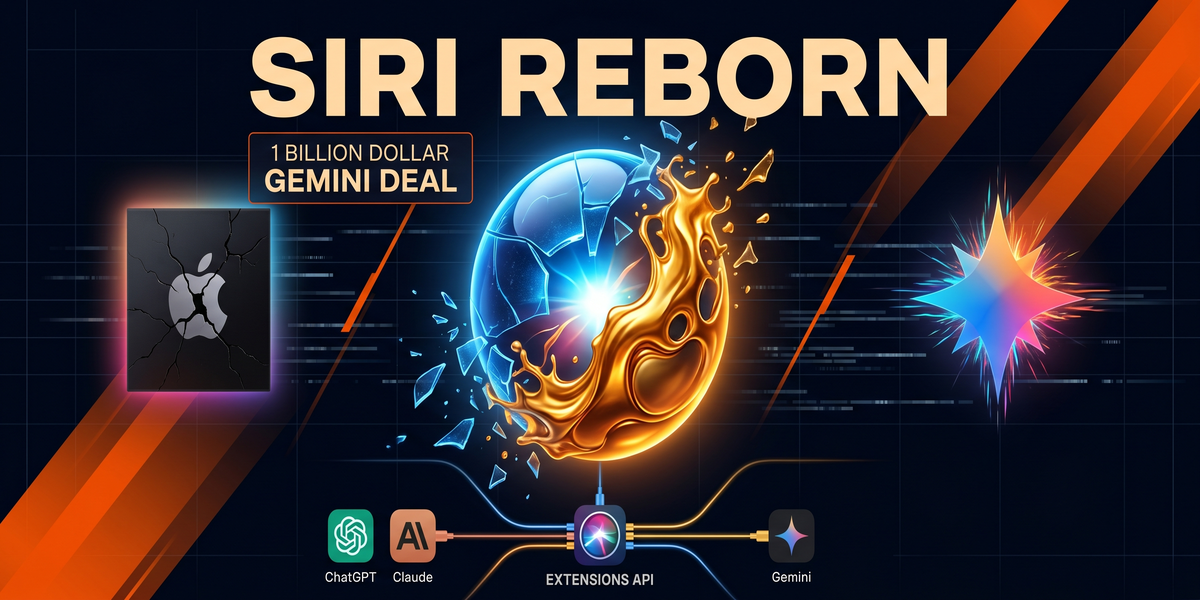
iOS 27 ships with an extensions API. One settings toggle and 1.4 billion iPhone users can route Siri queries to Claude or ChatGPT instead of Gemini. That's the largest AI distribution channel since the App Store.
And it's available to any developer who passes App Review.
The catch: the extension model is stateless.
No session context survives the hop. You can't build a memory-augmented assistant on top of this. Every query starts cold.
But the audience size is undeniable. Think about it like Spotify launching on the original iPhone App Store: enormous reach, new behavior pattern, early movers get habit formation on their side.
Side note: the docs for Apple's AI extension framework are already a mess. Expect six months of developer confusion before anyone ships clean examples.
What This Means for Your AI Stack Decisions
The real kicker: Apple is now dependent on Google for its most visible AI feature.
The company that spent a decade insisting it could do everything better in-house is writing nine figures a year to the competitor it once sued.
John Ternus inherits this in September when Cook steps down. The $1B Gemini deal runs for multiple years. Apple's AI roadmap is now partly contingent on a company they're simultaneously competing with and paying.
For small businesses and indie developers:
If Apple. With its cash reserves, its chip team, its hire-every-top-researcher strategy. Couldn't build a competitive AI assistant without outside help, you are not behind for using APIs. You're being prudent.
The question isn't whether to build or buy anymore. It's which vendor gives you the best reliability and pricing structure for your specific use case.
For AI tool developers:
The iOS user base just became addressable through a native-feeling interface. No separate app install. No friction. Just Siri routing to your model.
If your product answers customer questions, provides technical support, or handles any kind of natural language task, the calculus just changed.
The smart move: audit your current AI vendor contracts before Q4. Apple's entrance into the licensing market signals that compute demand isn't slowing down. Token pricing is going to get more volatile as company buyers with nine-figure budgets start locking in capacity deals.
If you've been putting off that Claude or Gemini contract negotiation.
Stop waiting. The market Apple just entered isn't getting cheaper.
FAQ Schema
How much is Apple paying Google for the Siri rebuild?
Apple is paying Google approximately $1 billion annually for the custom Gemini-powered Siri integration, a deal that represents a complete rebuild of Apple's virtual assistant using Google's AI technology.
When does the new Siri launch?
The rebuilt Siri ships this fall alongside iOS 27.
The beta rolls out today for developers at WWDC 2026, which runs through June 12 at Apple Park.
What can the new Siri actually do?
The new Siri has three core capabilities: personal context (reading emails, messages, files. And photos), on-screen awareness (seeing what's on your screen and acting on it), and cross-app automation that goes well beyond today's single-command shortcuts.
Will users be able to use other AI models with Siri?
Yes. iOS 27 includes an extensions API that lets users route Siri queries to Claude or ChatGPT instead of Gemini through a single settings toggle. This makes 1.4 billion iPhone users addressable through a native-feeling interface for any AI developer who passes App Review.
Why did Apple choose Google instead of building its own AI?
Apple Intelligence reportedly flopped in internal testing, and Apple faced a $250 million class-action settlement over undelivered AI features. Tim Cook reportedly took personal control of the AI roadmap and decided to license rather than build, spending $1 billion to save an estimated two years of development time.
Comments ()