
Bots Are Now the Majority of Your Website Traffic. Here's What That Actually Means.
TL;DR
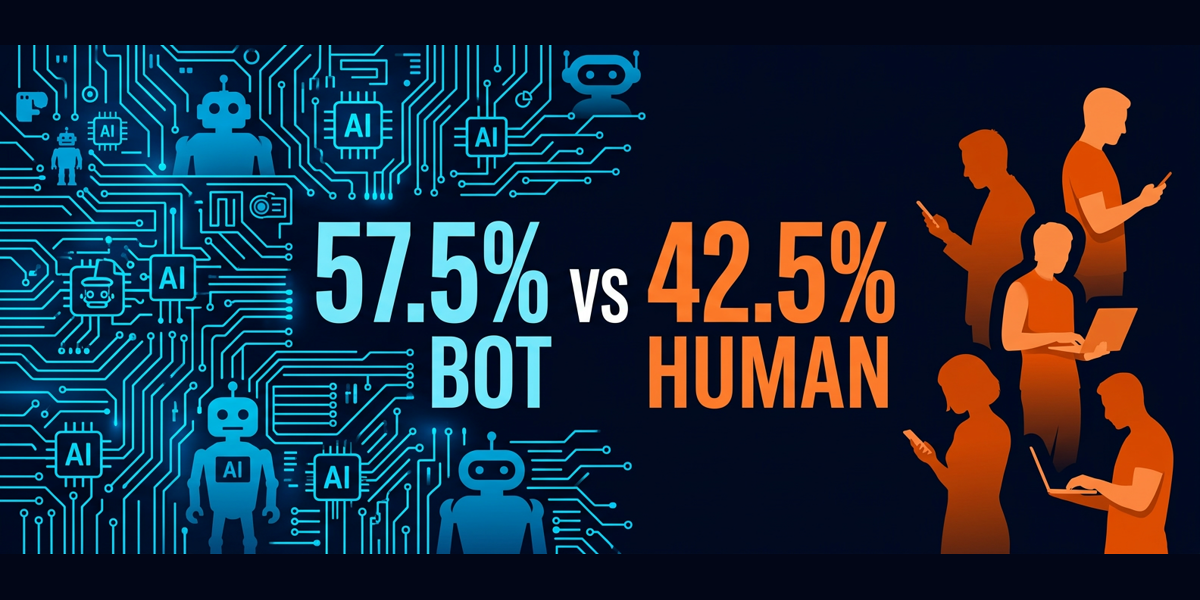
- Cloudflare clocked 57.5% bot HTTP requests vs42.5% human on June 3, 2026. First time in recorded internet history. - Matthew Prince, their CEO, predicted this crossover wouldn't hit until late 2027. It landed six months early. - If you're running a small business site, your analytics are showing you a number that's mostly machines. Machines that don't buy. Don't click. Don't fill out forms. - Automated traffic grew roughly 8x faster than human traffic in 2025, per Human Security. That gap? It's not closing. - The ad-supported web runs on human attention. Bots don't convert. That's not a theory anymore. It's a line item on your hosting bill.
---
So. Bots are officially the majority of internet traffic now.
Cloudflare dropped this on June 3, 2026.
Their CEO Matthew Prince called it a lament, which is a weird word for a guy who runs one of the biggest internet infrastructure companies on the planet. But I get it.
His own model said late 2027.
Wrong by six months. And the actual split — 57.5% bot HTTP requests, 42.5% human. Is uglier than the headlines make it sound.
If you own a website, sell anything online, or run ads against your traffic?
This isn't a tech-industry sidebar. It's the foundation of every metric you've been staring at for the past year.
Your Analytics Were Already Garbage. Now They're Worse.
Here's what the57.5% number actually means.
It counts HTTP requests. Not people. Not devices. A single AI agent hitting your pricing page 10,000 times in an hour shows up as 10,000 visits. Your dashboard treats each one identical to a human who landed there once, glanced around, and left.
The industry's own data backs this up. Anura says more than half of all web traffic in 2026 is bot traffic.37% from bad bots alone. The kind responsible for ad fraud, fake analytics, and wasted media budgets. Human Security found automated traffic grew 23.51% year over year in 2025. Human traffic?3.10%. That's an 8x growth differential. The machines are accelerating.
Humans are flat.
What this looks like in practice: if your analytics shows 10,000 monthly sessions, your actual human count is probably closer to 4,250. Maybe less.
You've been making decisions.
Ad spend. Content investment. Conversion optimization. Based on a number that was already inflated and is now getting worse.
On client work, we've started cross-referencing session counts against form submissions, chat interactions, checkout starts.
The gap between reported sessions and actual human engagement has widened noticeably over the past six months. If you're not doing that check right now, you're flying half blind.
The Ad Model Just Hit a WallHere's the part that should keep publishers and small business owners up at night.
The entire ad-supported model assumes human attention. Impressions, click-through rates, time on page.
All of it calibrated for people who actually see what they're clicking.
Bots don't click ads.
Don't scroll. Don't bounce and come back. A site serving10,000 "pageviews" where 5,750 are automated requests is effectively serving 4,250 human impressions. But being charged as if all 10,000 were real.
The math only worked when the split was reversed.
Prince floated a fix: charge bots for access. Whether that happens is a regulatory question, not a small business one. What small operators need to think about right now is whether the ad-supported model is still worth running when more than half your alleged audience is a machine.
For most small businesses, the answer was already no.
Display ads have been a losing proposition for anyone without serious traffic volume for years. This milestone just makes the underlying dysfunction impossible to ignore.
The Hosting Bill Nobody Is Talking About
Here's what scares me most for small operators: your server bill.
Every AI agent crawling, scraping, polling your site. That's bandwidth and compute. One HN commenter reported their employer's infrastructure seeing a single AI bot generate 1,500 requests per second. For a small business on shared hosting or a metered cloud instance? That's not a rounding error. That's a bill shock.
If automated traffic keeps growing 8x faster than human traffic, your server costs keep climbing while your actual customer count stays flat or declines.
The "just scale up" math breaks when the thing scaling up is machines, not buyers.
What to do: audit your server logs for request patterns that look automated. High-volume, no referrer, no session cookies, no time-on-page signal. If you see it, talk to your host about bot filtering or rate limiting. Cloudflare sells this, but so do others. The goal isn't blocking all bots. Search crawlers are legitimate. It's stopping the bleeding from traffic that will never convert.
Side note: Cloudflare's own docs on this are... a lot. Fair warning if you're going DIY.
What You Actually Do With This
Let me close the loop.
Your analytics platform is showing you a number that includes a bot majority.
Until you correct for that, every metric derived from it. Bounce rate, session duration, conversion rate — is unreliable.
First step isn't technical. It's recalibrating your mental model: treat reported traffic as an upper bound on real human traffic, not the actual count.
Then: audit. Cross-reference session data against events that require human action. Form submissions, clicks on phone numbers, checkout completions. Build a ratio. If you're in e-commerce, that ratio is your real conversion baseline.
If you're running lead gen, it's human contacts divided by reported sessions.
Finally: stop treating display ad revenue as a serious revenue line unless you have the traffic volume to negotiate directly with advertisers.
The programmatic ad market is priced on impressions. If those impressions are half bot, the CPM collapses. Or should.
This didn't happen overnight. It happened since AI agents started doing the work humans used to do online — researching, comparing, gathering. That's a real shift.
The operators who understand it now will adapt faster than the ones who keep staring at inflated session counts and wondering why conversion rates keep dropping.
Sources
Cloudflare's data: https://www.tomshardware.com/tech-industry/artificial-intelligence/bots-have-now-passed-human-traffic-online-cloudflare-boss-laments-says-agentic-traffic-wasnt-expected-to-eclipse-real-people-until-next-year
Anura bot traffic analysis: https://www.anura.io/blog/how-much-internet-traffic-is-bots
Human Security 2026 benchmark: https://www.humansecurity.com/learn/resources/2026-state-of-ai-traffic-cyberthreat-benchmarks/
Comments ()