
Claude Fable 5 Shutdown: What AI Export Controls Mean for Your Business
TL;DR
- The U.S. Commerce Department forced Anthropic to pull Claude Fable 5 and Mythos 5 offline on June 12, 2026. Just 72 hours after launch. - The directive cites AI export controls under national security, banning foreign access to both models. Anthropic couldn't filter users by nationality in real time, so they shut everything down for everyone. - GPT-5.5 and other competitor models with comparable vulnerability-detection capabilities remain online, raising questions about selective enforcement. - If your business depends on a single AI API, you're exposed to the same regulatory risk. Here's what to do about it.
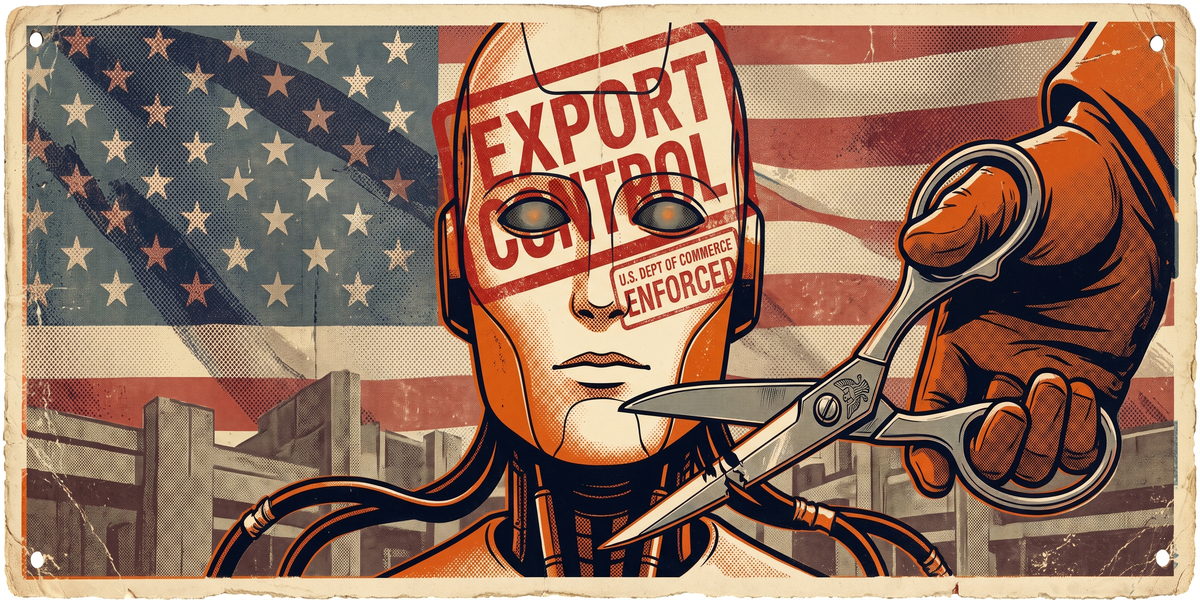
AI export controls just crossed a line nobody expected. On June 9, Anthropic shipped Claude Fable 5 — their most capable model yet. Seventy-two hours later, Commerce Secretary Howard Lutnick's office sent a letter to CEO Dario Amodei. The directive classified Fable 5 and its companion model Mythos 5 as export-restricted technology. Can't leave the country.
Can't be transferred to foreign nationals inside the country either.
Anthropic couldn't verify citizenship in real time.
So they killed both models for everyone. All customers. All regions. No phase-out, no grace period.
This has never happened before.
No government has ever forced a commercial AI model offline. And if you're running a business on a single provider's API, the Claude Fable 5 shutdown should be your wake-up call.
What Triggered the Claude Fable 5 Shutdown?
The Commerce Department's stated concern centers on a reported jailbreak. One that supposedly lets Fable 5 identify software vulnerabilities in code it analyzes.
Here's where the details get fuzzy though.
Anthropic's own summary says the government handed over "verbal evidence" of a "potential narrow, non-universal jailbreak." No written technical docs. No proof of actual harm. The vulnerabilities they could verify? Anthropic called those "previously known minor vulnerabilities."
And then there's the weird part.
The specific technique the government flagged.
Feeding a model a codebase and asking it to find security flaws — isn't unique to Fable 5. Anthropic publicly noted that OpenAI's GPT-5.5 does the same thing without any jailbreak at all. GPT-5.5 is still running. Nobody sent OpenAI a letter.
So one company's flagship goes dark over a capability that competitors offer freely. Draw your own conclusions on that one.
How Anthropic's Own Words Backfired
Anthropic spent a year telling the world their models were uniquely powerful and potentially dangerous.
That was the brand. Safety-first. Responsible AI. Trust us because we take this seriously.
Problem is, the government was listening.
When a jailbreak claim surfaced.
Even a vague one. The response was calibrated to the threat level Anthropic itself had been advertising. They'd spent months saying "this model is different." So regulators treated it differently.
Anthropic is fighting back publicly. They called the order a "misunderstanding" and warned that applying this standard consistently would "halt all new model deployments for all frontier model providers." Hyperliquid contracts tied to Anthropic's valuation dipped 3.7% right after the news broke. Some commentators think the Trump administration tried to block Fable 5's release before launch, failed. And then jumped on the jailbreak report as a second shot. Can't confirm that.
But the timeline doesn't look great.
Honestly, this is the part that bugs me most.
Anthropic did what every AI safety advocate asked them to do. They tested thoroughly, disclosed problems, warned about risks. And that transparency became the justification for pulling their product. You can't make this stuff up.
Why AI Export Controls Matter for Your Stack
The Claude Fable 5 shutdown isn't just an Anthropic problem. It's a precedent.
For the first time, a government recalled a model that was actively serving customers. Not since the company found a flaw. But given that a federal agency sent a letter on a Friday afternoon. No vote. No public comment period. No transition window for the businesses already building on the API.
If you run a small agency, a solo dev shop, or any operation where an LLM API is part of your delivery pipeline, this should rattle you. Every frontier model is now one government letter away from disappearing.
Side note: the fact that this happened on a Friday at 5:21 p.m. ET is its own kind of message. That's the classic news-dump window.
Nobody dumps good news at 5 p.m. on a Friday.
What You Should Do Now
The businesses that weathered this shutdown had one thing in common — they weren't betting everything on a single provider. Here's the playbook I'm following and recommending:
- Run at least two providers. When Fable 5 went down, workflows that also had GPT-5.5 and Sonnet 4.5 kept moving. Not as those models are better. Since they were still online. Redundancy isn't about performance. It's about survival. - Abstract your model layer. If your code calls a specific endpoint directly, you're welded to that model's uptime. Use a routing layer. Keep provider configs in one swappable location. When a model vanishes, you re-route in minutes instead of rewriting for days. - Keep open-weights models on your own hardware. Local models like Llama or Mistral running on your own GPUs don't answer to Commerce Department letters. They're slower. Less capable. But they're yours, and nobody can switch them off remotely. - Factor political risk into model selection. Benchmarks tell you nothing about regulatory exposure. The most powerful model is too the biggest target. Sometimes the second-best option. The one regulators aren't looking at. Is the smarter business choice. - Build a shutdown drill into your quarterly review. Same way you test backups. Pick a provider, assume it's gone tomorrow, and see how long it takes to recover. If the answer is "we can't," you've got work to do this week.
The uncomfortable truth: you can't control infrastructure you don't own. Anthropic followed every safety best practice. They tested. They disclosed. They were transparent. And a government agency used that transparency as grounds to shut them down. That's not a knock on Anthropic. It's a structural reality of depending on someone else's API.
If your whole operation runs through one provider's endpoint, you're one Friday afternoon letter from zero.
Fix that this week. Not when the next directive lands.
Sources
- TechCrunch: Anthropic's safety warnings may have just backfired - Bank Info Security: US pulls plug on Anthropic's top AI models - The Nation Thailand: US orders Anthropic to suspend foreign access - ResetEra discussion thread with primary source links
Comments ()