
DeepSeek V4 Is The End of the AI moat — Here's What Actually Changes
You know that feeling when a model drops and every tech blogger writes the same post? "DeepSeek V4 is amazing, here are the benchmarks, thanks for reading"? I'm not going to do that. I want to talk about what this actually means for you if you're running a small agency, a solo dev shop, or anyone who pays API bills.
Four days ago, DeepSeek released V4-Flash. It's $0.14 per million input tokens. Let that number sink in. Claude Opus runs about $15 per million. GPT-5.5 is somewhere in that range too. V4-Flash is not a toy model either. It scores within single digits of both on SWE-bench, which is the test that actually matters for production AI agents.
This is not a drill. The price-to-quality ratio just flipped completely.
The Math Nobody Is Talking About
Here's what I keep seeing in the hot takes: people listing the benchmarks, comparing the parameter counts, debating whether it's "really" as good as GPT-5.5. They're missing the point entirely.
Run the actual numbers. Say you're running a small AI-powered app. A writing tool, a support bot, a data pipeline with AI routing. You're processing 100 million tokens a month. With Claude Opus, that's roughly $2,500 a month. With V4-Flash, it's about $25.
Twenty-five dollars versus two thousand five hundred dollars. Same output quality on most tasks. You're telling me that doesn't change how you build your product? Because it changes everything.
The solo devs who figured this out first are already in production with hybrid routing setups. They send the heavy reasoning tasks to Opus or GPT-5.5 and route everything else to V4-Flash. Their cost per query drops by 90% and their users can't tell the difference. That's not a prediction. That's what's happening in dev forums right now, 72 hours after launch.
If you're still routing everything to one expensive model because it's comfortable, you're leaving money on the table. Simple as that.
The Chip Story Is Bigger Than It Looks
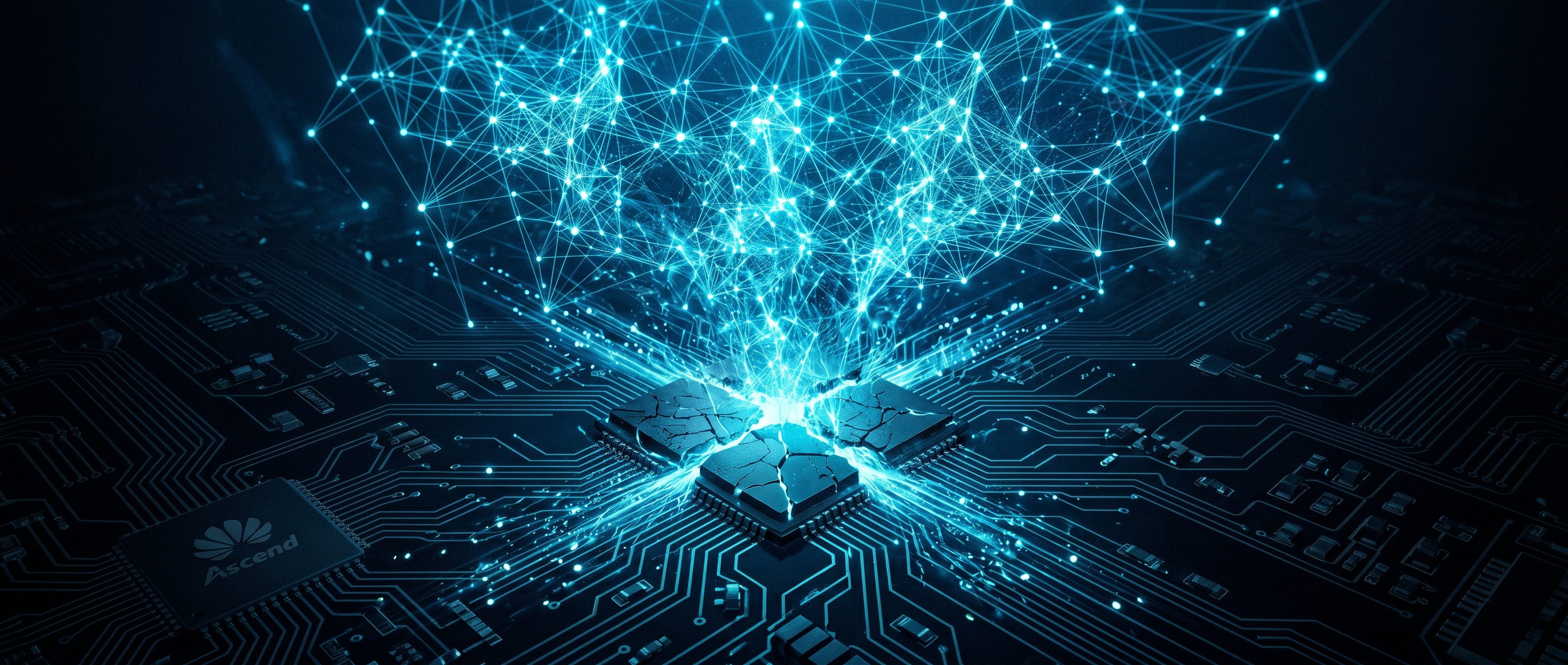
Here's the part that Silicon Valley is quietly burying. V4 was built on Huawei Ascend chips. Not Nvidia. Not H100s. This is the first DeepSeek flagship model that didn't touch Nvidia hardware during training.
Jensen Huang called this exact scenario "a horrible outcome for the US" on the Dwarkesh Podcast about a year ago. He was right from a US export-control perspective. China's AI stack just proved it can produce a frontier model that trades blows with GPT-5.5. That is a big deal for global AI geopolitics, and I don't say that lightly.
But here's my contrarian read: for small businesses, chip independence is actually a feature, not a risk. The more fragmented the hardware landscape becomes, the less power any single chip company has over AI pricing long-term. Nvidia's CUDA moat is real but it's not eternal. Every model that runs well on alternative hardware is a step toward compute commoditization.
You don't need to care about Huawei or Chinese tech policy. You just need to care about the fact that the underlying cost structure of AI is finally, genuinely competitive. That's the real story here, not the geopolitics.
Open Source Changed the Rules Overnight
That era is over.
V4-Pro has 1.6 trillion parameters, a million-token context window, and scores within 7-8 points of GPT-5.5 on the benchmarks that matter. It's MIT-licensed. You can download it and run it yourself today. The quality gap between open and closed is now measured in single-digit points, not cliffs.
For small shops, this is the moment to stop being dependent on any single API. Build your pipeline model-agnostic now. If your entire product breaks when one provider changes their pricing or has an outage, that's a structural problem, not a technical one. V4 gives you a viable fallback that actually works.
The moat for closed-source companies isn't gone, but it's getting thin. And the companies that built model-agnostic products from day one are going to have a much better time in the next 18 months than the ones who didn't.
What You Should Actually Do
First, run the numbers on your current API costs. Pull your logs, estimate your token usage per model, and calculate what a hybrid routing setup would save you. If you're spending over $500 a month on AI inference, V4-Flash routing probably saves you 80% on the queries that don't need premium reasoning. That's real money for a small shop.
Second, set up basic routing if you haven't already. You don't need a sophisticated agent framework. Even a simple rule that sends coding tasks to one model and general text tasks to another moves the needle. The Vercel AI Gateway changelog has the implementation details. It's not complicated and it works in production today.
Third, audit your lock-in. If your product would genuinely break if one API went down or changed pricing significantly, that's the problem you need to solve this quarter, not later. V4-Flash is the cheapest viable fallback that's ever existed. Use it.
The AI cost structure just changed in a way we haven't seen since R1 dropped prices by 95%. But this time the quality held up. That's the difference. That's why this matters for you specifically.
Stop waiting for the "right time" to optimize your AI costs. The right time is right now.
Sources: DeepSeek V4-Pro on HuggingFace | AIthority - Multi-Model Routing in 2026 | Business Today - DeepSeek V4 vs Nvidia | Dev.to - V4 for AI Agents | Vercel Changelog - V4 on AI Gateway | Hacker News Discussion
Comments ()