
Eleventy Is Dead. Long Live Build Awesome. The Web Dev Community Isn't Having It.
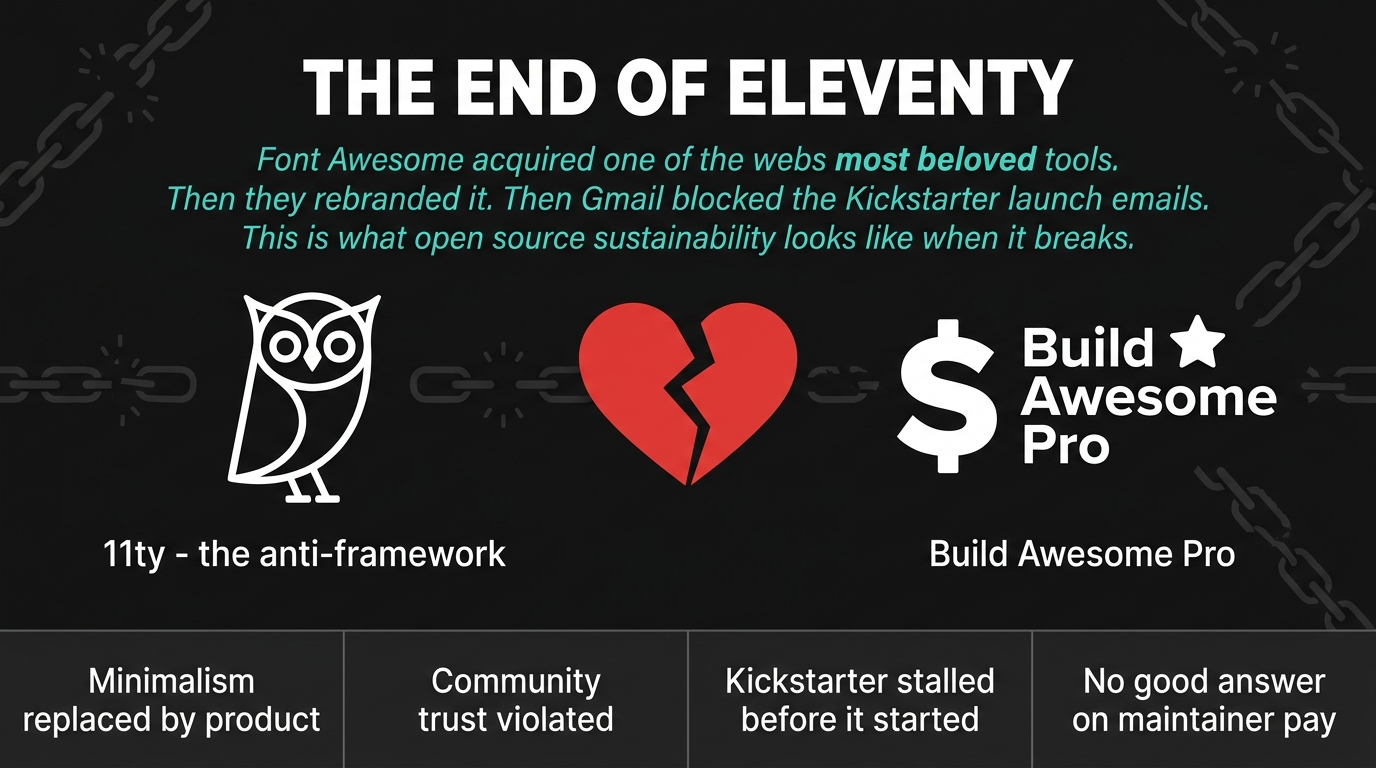
Font Awesome launched a Kickstarter on April 11 to rebrand Eleventy, one of the most beloved static site generators in web development, as "Build Awesome." It hit its $40,000 goal in a single day. Then the backlash hit.
The HN thread hit 186 points with 147 comments in twelve hours. Users are calling it the end of an era. Eleventy was positioned as an anti-framework framework, deliberately minimal and unopinionated. Now it is being absorbed into Font Awesome's commercial ecosystem. The Kickstarter was then paused because Gmail blocked their launch emails to 99% of recipients. The story is still unfolding.
The Anti-Framework Got a Makeover
Eleventy was created by Zach Leatherman in 2017 as a minimal, flexible static site generator. It deliberately avoids dictating client-side JavaScript. It supports ten different templating languages. It is famous for being the web framework that does not want to be a framework.
That philosophy built a remarkable user base. Eleventy is used by NASA, CERN, TC39, W3C, Google, Microsoft, Mozilla, Apache, and freeCodeCamp. In a web development world that keeps adding complexity, Eleventy was the option that respected your intelligence and your autonomy.
Leatherman was initially hired by Netlify to work on Eleventy full-time. In September 2024, Eleventy moved to Font Awesome with Leatherman joining their team. Now in 2026, Font Awesome is launching "Build Awesome" and "Build Awesome Pro" — effectively a commercial rebrand. The Kickstarter describes it as the all-in-one site builder for Font Awesome and Web Awesome.
The web dev community noticed the shift in direction immediately.
Open Source Has No Good Answer for This
The tension underneath this story is one the web dev community has struggled with for years. How do you pay for open source infrastructure without changing what made it valuable?
Netlify funded Eleventy's development. Then Font Awesome acquired it. Both times the community watched the project shift ownership and eventually direction. The people who built Eleventy's ecosystem feel like they invested in something that got sold out from under them.
One commenter on HN put it simply: "I've been using the same version of Jekyll for ten years in a Docker container and I refuse to upgrade." The point is not Jekyll. The point is that static site generators work fine without active development. They do not need to be products.
Another commenter noted: "The beauty of SSGs in one sentence: CVEs in HTML do not exist." That captures why people loved Eleventy. It did not have the attack surface of a modern JavaScript framework. It was fast, it was stable, and it did not require constant maintenance to stay safe.
Nobody has solved the maintainer problem without eventually changing a project's soul. The Eleventy story is the latest example. Netlify could not make it work financially. Font Awesome thinks they can. The community is not convinced.
The Kickstarter Failed Before It Started
Here is the part that should concern Font Awesome even more than the backlash.
The campaign hit its goal in a day. That sounds like momentum. Then Gmail blocked 95% of the launch emails. The Kickstarter paused before most of Font Awesome's own audience knew the campaign existed.
Kickstarter campaigns live and die by first-48-hour momentum. This one stalled before most of the people who should have cared even knew it existed. That is not bad luck. That is a signal that even the people closest to this project were not paying attention.
Maybe the community had already moved on. Maybe the email list was never as engaged as Font Awesome assumed. Either way, a campaign that needed visibility could not reach its own subscribers. That is a different kind of problem than bad press.
What the Community Is Saying
The reaction is consistent and blunt. This feels like commercial capture of an open-source project that was built on community trust.
The people who contributed to Eleventy's ecosystem, who wrote plugins, who filed bug reports, who recommended it to colleagues — they feel like stakeholders in something that got reorganized without their input. The philosophy that made Eleventy worth using is now being replaced by the philosophy that makes products sell.
Whether that is fair or not is less important than what it reveals. Open source projects that build strong communities do so because they earn trust over time. Rebuilding that trust after a commercial pivot is harder than launching a Kickstarter.
The Eleventy project will probably keep working. Static sites built on it do not stop functioning because the brand changed. But the relationship between the project and its community has changed, and that is not easily undone.
Sources: - The End of Eleventy — Brennan Day - Font Awesome — Pausing Kickstarter - Build Awesome Kickstarter - Hacker News Discussion