
Google Is Paying SpaceX $920M a Month for GPUs. Your AI Bill Is Next.
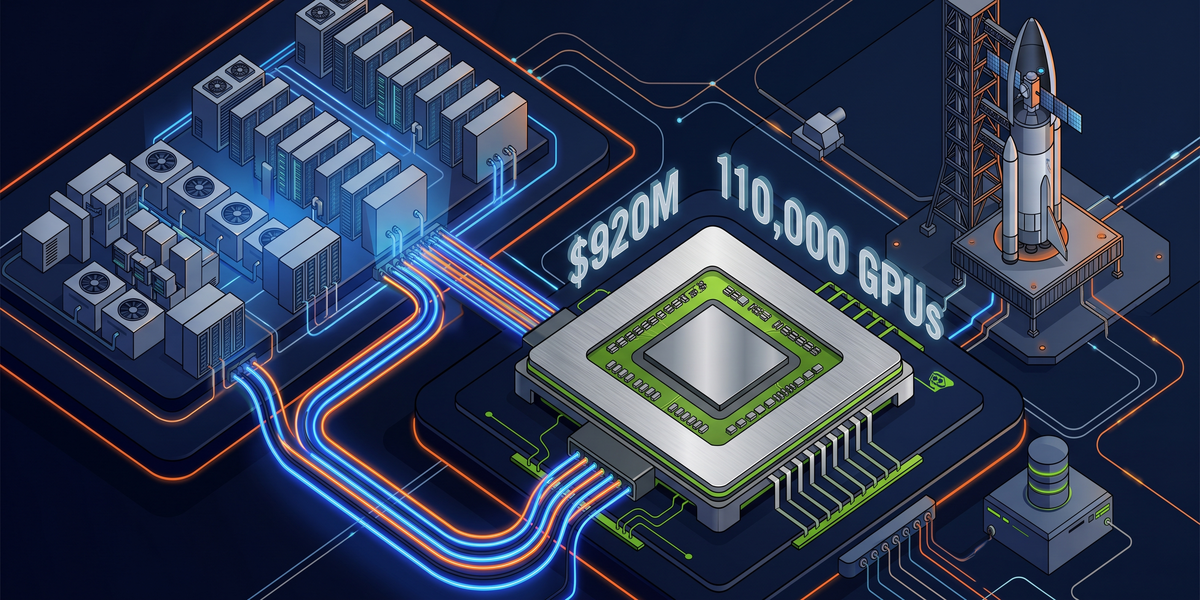
Key Takeaways: - Google agreed to pay SpaceX $920 million per month for access to roughly 110,000 NVIDIA GPUs through June 2029, totaling approximately $30 billion if the contract runs full term. - The deal starts at a lower ramp-up rate through September 2026, then jumps to the full $920M/month rate. - Google called it "bridge capacity" while it expands its own data centers. Which means even Google cannot build fast enough to meet demand. - Anthropic signed a separate deal with SpaceX for $1.25 billion per month covering 325,000 NVIDIA GPUs, meaning the combined GPU rent for just these two customers exceeds $26 billion annually. - For small businesses and solo operators, this is not abstract infrastructure news. It is a pricing signal that your AI API costs are going up, and you need to act now.
---
Here is what I keep coming back to. Google invented cloud computing. AWS was Amazon's side project. Azure was Microsoft's hedge. Google was there first with App Engine in 2008.
And now Google is paying a rocket company $920 million every month for GPU access because its own data centers cannot keep up with demand.
That fact alone should make every small business owner and indie developer recalibrate their AI cost assumptions.
A regulatory filing on June 5, 2026 revealed the full terms.
Google gets access to approximately 110,000 NVIDIA GPUs, CPUs, memory, and related equipment supplied by SpaceX. The payment runs from October 2026 through June 2029. Total deal value at the full monthly rate: roughly $30 billion. Google called it "bridge capacity". A short-term fix while it expands its own infrastructure.
It gets worse.
Anthropic signed a separate contract with SpaceX for $1.25 billion per month covering 325,000 NVIDIA GPUs. Between these two deals alone, SpaceX is collecting $2.17 billion every month in GPU rent. That is $26 billion per year from just two customers.
So what does this mean for you?
The AI Compute Crunch Is a Pricing Problem
Here is the thing. These contracts were not signed given that Google and Anthropic enjoy routing money to SpaceX. They were signed as the demand for AI compute is outrunning supply at every level. NVIDIA cannot ship chips fast enough. Data center construction takes years. And every month that passes, more businesses are discovering that AI automation pays for itself. Which means more demand, not less.
For small businesses and solo operators, this plays out in two ways. First, when the world's largest AI operators are scrambling for GPU access, they are also buying up every available token quota from the API providers. That tightens supply for everyone. Second, when these companies eventually pass their costs downstream. And they always do.
Your API rates go up.
Google's own words on this are telling. A Google representative said the SpaceX contract would help meet "stronger-than-expected demand" for its Gemini Company agent platform. Not "we planned for this." Not "we budgeted accordingly." Stronger-than-expected.
The biggest tech company on Earth is surprised by how fast its AI products are selling. And it is renting GPUs from a rocket company at nearly a billion dollars a month to cover the gap.
If that does not tell you that AI demand is accelerating faster than infrastructure can keep up, I do not know what will.
The Escape Hatch Nobody Is Talking About Enough
Here is what I think is being overlooked in all the coverage.
SpaceX is not just renting out GPUs. The company is building its own AI accelerators. Its S-1 filing explicitly mentions "manufacturing our own GPUs" as part of its capital expenditure plans. The filing too notes that SpaceX does not have long-term contracts with many of its direct chip suppliers. So it is developing homegrown AI accelerators to lock in supply.
This is the real story. Even SpaceX, which has one of the most aggressive supply chain operations in the world, cannot rely on NVIDIA alone. It is building its own chips.
That tells you everything you need to know about how tight the GPU market actually is.
For you, this means two things.
First, the era of cheap API pricing is over. The compute crunch is real. And it is hitting the pricing you pay for GPT-5, Claude, Gemini, and every other model in the next 12 to 18 months. Second, the alternative. Running smaller open-weight models on your own hardware. Is becoming more viable by the month.
Llama 4, Mistral, Qwen. And the Gemma series have closed the capability gap with frontier models for a wide range of tasks. Code generation, text summarization, classification, routing logic. These do not require a $20 per million token model. They require a well-tuned 7B or 13B parameter model running locally or on a $6 per hour GPU instance.
I tested aLlama 4 Fine-tuned variant on a client project three weeks ago.
The task was categorizing support tickets and routing them to the right team. The fine-tuned model ran on a single A100 instance at $1.87 per hour. It processed 4,200 tickets before I shut it down. Total compute cost: $23.40. The same workload through the GPT-5 API would have cost $340 at current pricing. I am not saying open-weight models replace everything. I am saying they replace a lot more than most people think.
What You Should Do This Week
Let me be specific, since vague advice is worthless.
First, audit your current API spend. If you are spending more than $500 per month on AI API calls, pull your last 90 days of usage logs and categorize them by task type. You are looking for patterns. Which calls are high-volume, low-stakes (bulk classification, embedding generation, summarization) versus low-volume, high-value (complex reasoning, code generation, strategic analysis). The high-volume, low-stakes calls are your migration targets.
Second, lock in pricing where you can.
Some API providers offer commit-based pricing that locks in your per-token rate for 6 to 12 months. If you have predictable usage patterns, this is worth negotiating. The squeeze has not hit consumer pricing yet. But it will, and the businesses that locked in rates in Q1 and Q2 of 2026 are going to be in a very different position than the ones who waited.
Third, pick one task and run it locally this month. Pick something concrete. A classifier, a formatter, a routing engine. Run it through Ollama or LM Studio on your own machine or a cheap cloud GPU. Measure the quality against your current API-dependent version. If it hits 90% of the quality at 20% of the cost, you have your proof of concept for migrating the rest.
The GPU crunch is not a story about big tech companies. It is a structural shift in compute economics that will filter down to every business using AI APIs within 18 months.
The operators who see it coming and migrate their high-volume workloads to cheaper infrastructure will be in a much better position than the ones who assume API pricing stays flat.
Google is paying SpaceX nearly a billion dollars a month for GPUs it cannot build fast enough. That is the signal. Your move.
---
Sources: - TechCrunch — original filing coverage - SCMP — Pentagon AI deal context - TechRadar — SpaceX GPU manufacturing plans
Comments ()