
Google's Researcher Left After a Short Stint. Then Another Notable Figure Quit Too.
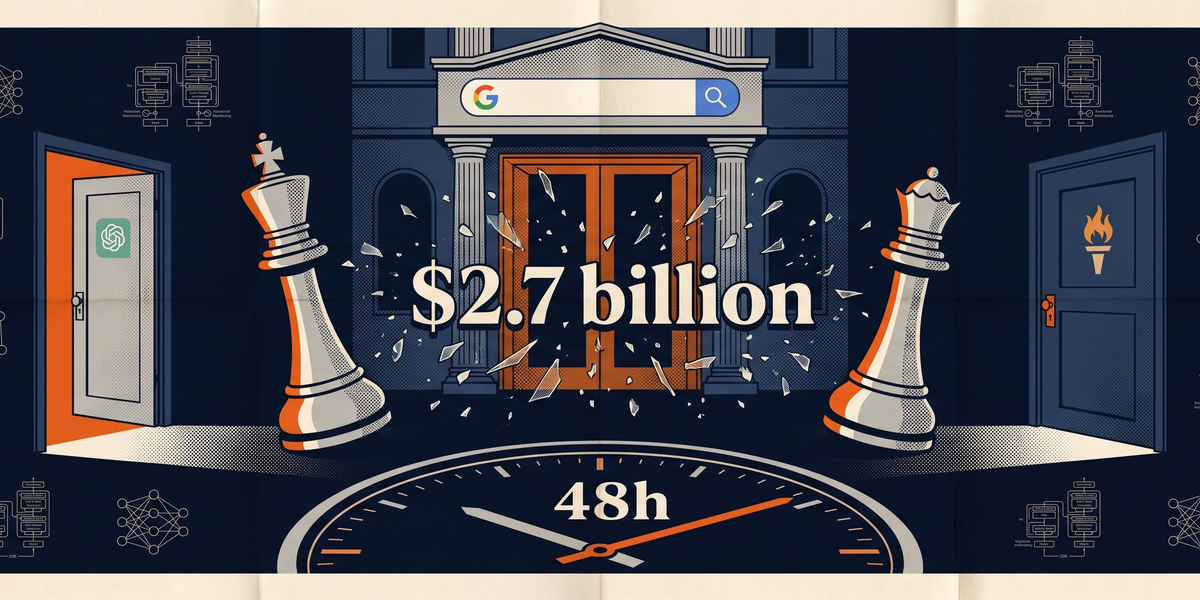
Noam Shazeer announced he's heading to OpenAI. VP of engineering. Co-lead of Gemini.
One of eight authors on the "Attention Is All You Need" paper.
The one that invented the transformer architecture powering basically everything you're shipping right now.
Shortly after, John Jumper followed. A notable figure in the field.
AlphaFold co-creator. Out of DeepMind. Into Anthropic.
Two of the most credentialed AI researchers alive.
Both walked out the same door within a brief period.
Here's why that should make you rethink your entire AI stack.
What Actually Happened at Google
Google paid a significant amount to bring Shazeer back. Licensing deal with Character.AI, the startup he co-founded after leaving Google.
He'd originally left because Google wouldn't fund his Meena chatbot. Came back for the massive check. Stayed less than two years.
CNBC called it an acqui-hire.
Google wanted the researcher, not really the company.
Shazeer called it "difficult" on X.
Said he was "incredibly proud" of the Google team. "Excited" to join OpenAI.
Google called him "meaningful." Nobody explained why he was gone less than two years after returning.
Side note: their internal politics are a mess.
Always have been.
Why This Is Not Just Industry Gossip
If you've been locking your roadmap into one AI vendor's API, this matters to you directly.
The people who built the models you're calling? Not the same people who built them last year.
Not even six months ago.
They're at OpenAI, Anthropic, and whatever startup they spin up next.
LinkedIn News framed it as a bet on OpenAI ahead of its IPO.
Fast Company noted that hiring someone with Shazeer's credentials before an IPO looks good to investors.
That's the play.
Not that the models improve. That the company gets bought.
You're not a VC.
You're an operator. You need reliability. Predictable pricing.
The same capabilities next quarter that you had last quarter.
When the co-lead of your vendor's flagship model posts a resignation and links to a competitor's careers page, that predictability takes a hit.
The Multi-Vendor Point Is Not Optional Anymore
Honestly, I've been running AI automation for small client operations for a while now.
The old advice used to be "pick a primary vendor, keep a backup warm." That doesn't cut it anymore.
The researcher churn rate at frontier AI labs?
Not a side channel signal. It's the main channel.
When the architect of your API dependency publicly decides the grass is greener at the company competing directly with them, your risk model needs a new row.
Here's what I'd do if I were running a lean operation with meaningful AI dependencies today.
Audit your vendor concentration first.
Which single departure would most disrupt your product? If it's one person at Google DeepMind or one team at OpenAI, you need a parallel track running already.
Run a multi-model evaluation on your actual workload, not on benchmarks. Send the same requests across various models. See what breaks.
Lock in any multi-year pricing you can negotiate now. When the talent leaves, the pricing often follows.
Here's the uncomfortable truth: you're along for the ride.
Google is losing the people who built its AI moat. Anthropic and OpenAI are gaining them. Neither outcome guarantees better or worse service for you.
But it guarantees your roadmap is less stable than the one you signed up for.
The Real Asymmetry Nobody Is Talking About
Here's the part nobody's saying out loud.
When Shazeer left Google, institutional knowledge walked out the door with him. Not just code. The understanding of what works, what doesn't, where the shortcuts live, where the debt hides. That knowledge is now at OpenAI. When the next researcher leaves, the same transfer happens again.
If you're choosing which AI stack to bet your product on, the talent distribution matters as much as the benchmark scores.
The company staffed by the people who invented the techniques your models use?
Probably going to move faster on edge cases the benchmarks don't measure. The company losing those people to competitors? Probably going to be slower about it.
And probably going to raise prices to make up the difference.
That's not a recommendation to switch vendors today.
It's a recommendation to run your infrastructure so you can switch within days, not months.
The next resignation post is already being drafted somewhere.
Audit your lock-in. Run a second model in production for one workflow this week. If you're building your whole product on one vendor's roadmap, two resignation posts on X just showed you why that's a bet, not a strategy.
Sources
CNBC. Noam Shazeer joins OpenAI Reuters. AI talent competition Fast Company — Shazeer IPO bet LinkedIn News — Shazeer move coverage
Comments ()