
Meta Kills Free AI Models. Muse Spark 1.1 Costs Money.
TL;DR
- Muse Spark 1.1 is a closed-weight AI model from Meta. You access it through the Meta Model API at $1.25 per million input and $4.25 per million output tokens. - New devs get $20 in starter credits before billing kicks in. US-only during public preview. Everyone else gets access errors. - The earlier Muse Spark hit 52 on the Artificial Analysis Intelligence Index, landing top 5 behind Gemini 3.1 Pro, GPT-5.4, and Claude Opus 4.6. - Meta plans to swap out existing Llama models across Instagram, WhatsApp, Facebook, and its smart glasses for Muse Spark 1.1. - Price-wise it lands above Claude Haiku 4.5 and GPT-5 mini but below Claude Sonnet 4.6 — mid-tier territory.
That's how long Meta spent handing out Llama models for free, undercutting OpenAI and Anthropic and Google by just... giving the weights away. Download them. Run them locally. Modify them. Whatever.
That era is done.
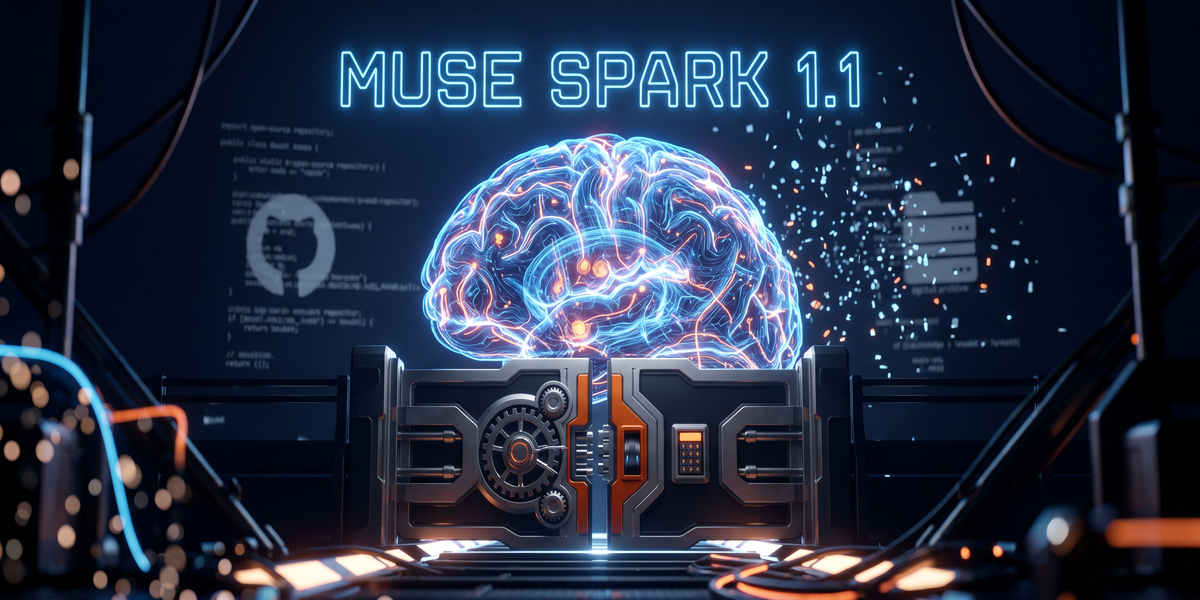
Muse Spark 1.1 is proprietary.
Closed-weight. Metered API only. The company that practically built its AI reputation on open access now wants your credit card before you can touch its best model.
What's Muse Spark 1.1 Built For?
Meta's pitch is agentic work.
Tool use, multi-step chains, debugging code, processing images and video alongside text. Think of it as a model designed less for writing marketing copy and more for chaining API calls together. Fetch, analyze, draft, trigger. That kind of thing.
You can poke at it right now in "Thinking mode" on the Meta AI app or website without writing any code.
But honestly? Every capability claim right now comes straight from Meta's own marketing. No third party has put version 1.1 through independent benchmarks yet. Zero. So treat the "most capable model" framing with appropriate skepticism.
Meta also says this model will replace Llama across WhatsApp chatbots, Instagram, Facebook, and their smart glasses. That's a massive deployment footprint.
If the model struggles under that kind of load, we'll know fast.
Side note: for small operators running agentic workflows, the interesting question isn't whether it's "good" in some abstract sense. It's whether it handles multi-tool chains better than Claude Sonnet 4.6 or GPT-5.4 at a comparable price point. That's what actually determines whether you switch.
And we don't have that data yet.
Is the Pricing Actually Competitive?
$1.25 per million input tokens. $4.25 per million output.
Put that side by side with the competition and here's what you see. It's pricier than GPT-5 mini and Claude Haiku 4.5. Cheaper than Claude Sonnet 4.6. Meta is planting a flag in the middle of the market.
Not racing to undercut anyone. Not premium pricing either. Just... middle.
That tells you who they're chasing.
Developers who've outgrown budget-tier models but wince at Sonnet 4.6 invoices. Fair enough. That's a real and underserved segment.
The $20 free credit situation is genuinely useful. At those rates you get a substantial number of input and output tokens to play with before the meter starts. Enough to run real workflow tests, not just send a hello prompt and call it evaluated.
The actual problem?
Geography. Meta Model API is US-only during public preview. I've seen developers in Europe and Asia reporting access denials already. If your infra serves international clients or your team is distributed, you need a backup provider lined up until Meta expands. No rollout timeline announced, which is kinda frustrating.
Why Does Closed Weights Matter So Much?
This is the part that stings for a lot of people.
Muse Spark 1.1 is a significant shift for Meta as it is not available for download, modification, or self-hosting. That's a genuine turning point.
Artificial Analysis, the independent benchmarking org, confirmed this shift.
They too noted that the previous Muse Spark scored 52 on their Intelligence Index. Top 5 globally, behind only Gemini 3.1 Pro, GPT-5.4, and Claude Opus 4.6. For a first-gen frontier push from Meta, that's not shabby. Artificial Analysis essentially said Meta closed the gap to the frontier in a single release cycle.
But the performance numbers are getting buried under the open-weights argument.
Reddit threads and Hacker News are split pretty hard. Some devs are relieved to see pricing pressure on OpenAI and Anthropic. Competition is good, cheaper APIs are good. Others feel like Meta spent years building trust with the open-source community and then pulled the rug. Both takes have merit.
Tbh the practical question gets lost in the ideology dust cloud. Does Muse Spark 1.1 outperform what you're already paying for?
That's the only metric that should drive your decision.
Should You Actually Try Switching?
Use the free credits. That's my whole recommendation.
Send the same prompts and tool chains through Muse Spark 1.1, Claude Sonnet 4.6, and GPT-5.4 simultaneously. Compare what comes back. Compare latency.
Compare cost on your actual workload — not some synthetic benchmark suite that doesn't reflect what you ship.
The multimodal stuff (text, images, video) plus agentic tool use makes it worth at least evaluating if your workflows touch visual data.
Thinking mode in the Meta AI app is the zero-commitment way to start.
But don't rip out your existing stack based on Meta's word. No independent Artificial Analysis score for 1.1 exists yet. The API is US-only. And closed weights mean if Meta hikes prices or tightens access in six months, you've got no local fallback. You're locked in.
So test in parallel. Decide with data. And those free credits won't last — burn through them now while you can still evaluate for free.
Muse Spark 1.1 is live at meta.ai in Thinking mode and through the Meta Model API for US-based developers.
Sources
- Yahoo Finance: Meta debuts Muse Spark 1.1 - Artificial Analysis on X - Meta AI Blog: Introducing Muse Spark - Handy AI: Model Drop, Muse Spark 1.1
Comments ()