
Nvidia Built Its Own Money Printer With GPU Financing
TL;DR
- Nvidia invested about $1 billion in AI startups in 2024 through NVentures, and a big chunk came right back as GPU orders. - For every $10 billion Nvidia puts into OpenAI, NewStreet Research pegs the return at $35 billion in GPU sales and lease payments. - Nvidia owns 7% of CoreWeave and signed a deal to purchase $6.3 billion in cloud services from it. Invested capital that circles back as revenue. - Jensen Huang called OpenAI the next "multitrillion-dollar" company after committing up to $100 billion. - Analysts describe circular financing as a key mechanism in the AI hardware ecosystem.
Nvidia shoveled roughly $1 billion into AI startups during 2024 through its venture arm NVentures, per Dealroom and the Financial Times. Here's the fun part. A fat slice of that cash bounced straight back as GPU purchases. Not a bug.
The whole point.
And tbh, if you're paying for API access to any big language model right now?
You're already inside this thing.
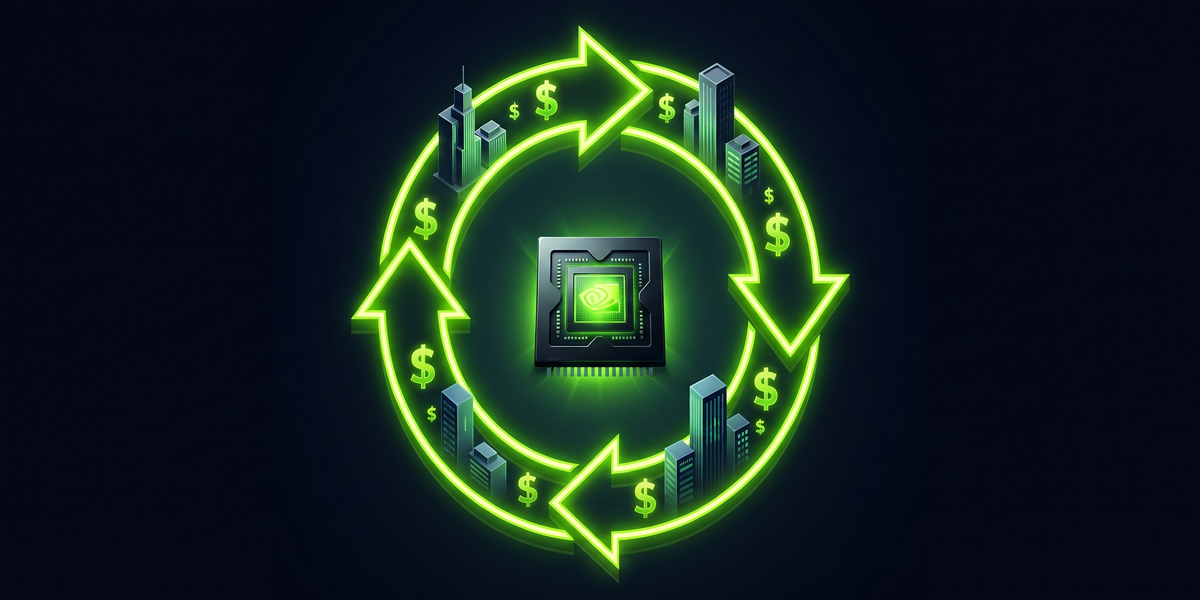
The Money Goes in a Circle
Here's how the machine runs.
Nvidia drops cash into an AI startup.
That startup needs compute badly. So it spends the investment on Nvidia GPUs. Nvidia records that as revenue. Then Nvidia funnels a portion of that revenue back into more investments in the same companies. Round and round.
This isn't some conspiracy theory floating on Reddit. Built In's analysis defines circular financing as "a funding arrangement in which companies supplying a product or service are also major investors," creating a loop where capital flows back through purchases, equity swaps, or long-term contracts.
The clearest example? Nvidia holds about 7% of CoreWeave.
Then Nvidia agreed to purchase $6.3 billion in cloud services from CoreWeave, as Fortune reported. So Nvidia bankrolls CoreWeave. CoreWeave buys Nvidia GPUs to build out its infrastructure. Nvidia becomes CoreWeave's biggest customer. Three steps, one revenue pipeline, all landing on the same balance sheet.
Goes deeper though.
Nvidia's equity positions in outfits like OpenAI and CoreWeave help those companies borrow at lower rates. Lenders see Nvidia's name on the cap table and cut the interest on data-center debt. Cheaper debt means more GPUs purchased. More GPUs purchased means more Nvidia revenue. Every revolution of the flywheel makes the next one faster.
Why $10 Billion Becomes $35 Billion
NewStreet Research actually crunched the numbers on the OpenAI deal specifically. Their estimate: for every $10 billion Nvidia invests in OpenAI, Nvidia sees $35 billion in GPU purchases or GPU lease payments.
That's roughly 27% of Nvidia's annual revenue from its last fiscal year, as Fortune reported.
Sit with that for a second.
You put in $10 billion. You get back $35 billion in sales. Plus you hold equity in the very company you just turned into your largest customer. And because those customers are welded to Nvidia's CUDA software platform, jumping to a rival would mean rewriting their entire training stack from scratch.
Hardware moat feeds the software moat.
Software moat feeds the hardware moat. They prop each other up.
The Nvidia-Oracle-OpenAI triangle makes it even more obvious. As a LinkedIn analysis describes, Oracle buys billions in Nvidia GPUs for its cloud.
OpenAI raises money for its $100 billion "Stargate" data-center project and dumps that cash into Oracle's Nvidia-powered cloud. The money travels from OpenAI to Oracle to Nvidia. Circle closed.
Jensen Huang pitched the $100 billion OpenAI investment as backing the next "multitrillion-dollar" company, per Yahoo Finance.
Janus Henderson. A serious asset manager. Labeled the whole arrangement a "virtuous circle" that aligns suppliers, builders. And customers to meet surging compute demand. Can't argue with the alignment part.
But "virtuous" only works if the demand underneath is real.
The Loop Unravels Fast Under Stress
This is the part that keeps me up at night.
Analysts describe circular financing as a key mechanism in the AI hardware ecosystem, per Built In. Same analysis calls it the "only strategy fast and flexible enough" to match AI's pace, binding startups, suppliers. And investors into what one analyst described as "one big blob."
That blob helped push record highs in U.S. stock indices, as Yahoo Finance noted.
Nvidia's circular deals inflate the valuations of every company inside the loop. OpenAI, CoreWeave, Oracle, Nvidia. They all look more valuable given that they keep buying from and investing in each other. Round and round.
Fortune and others warn these circular transactions may give investors an inflated perception of true AI demand.
Honestly, I don't see how they're wrong. When a meaningful chunk of GPU sales is effectively bankrolled by the GPU seller itself, you gotta wonder how much demand is organic versus manufactured. If OpenAI's revenue growth stalls. Or if one of the neoclouds trips. The loop tightens fast. Nvidia eats the $6.3 billion CoreWeave commitment. CoreWeave's cheap debt gets repriced upward. The flywheel turns into dead weight.
I run a small AI consulting shop.
My clients pay for API calls to models trained on GPU clusters that exist as of this financing arrangement. If the loop cracks. Even slightly. GPU pricing jumps, API costs spike. And every AI project I've shipped in the past 18 months gets worse economics overnight. You're probably sitting in the same spot.
What You Should Actually Do
Practical moves. Not complicated.
GPU supply is artificially abundant since Nvidia is underwriting demand with its own balance sheet. That's a window. Windows don't stay open.
Lock in whatever long-term cloud contracts you can at today's rates before pricing shifts.
Start benchmarking open-weight models you can self-host. You need a fallback if API costs lurch upward. Build your project cost models with padding for compute price hikes. If the circular financing loop softens, those increases will land faster than anyone's modeling for.
The companies inside this loop aren't dumb. Nvidia, OpenAI, Oracle, CoreWeave. They're running a strategy that produces big revenue right now. But strategy isn't sustainability.
When one company functions as investor, supplier, customer.
And demand backstop all at once, the whole structure hinges on that company keeping the money flowing.
Nvidia's circular GPU financing machine built the AI infrastructure we all use daily.
It too made that infrastructure dependent on a feedback loop nobody's stress-tested in reverse.
If your business runs on AI APIs, audit your compute spend today. Price out a fallback.
The loop looks solid. Until suddenly it doesn't.
Sources
- Fortune. Nvidia and OpenAI circular financing - Built In — AI circular financing analysis - Yahoo Finance — AI boom's reliance on circular deals - LinkedIn — Spandan Bhattacharya on the Nvidia-Oracle-OpenAI triangle
Comments ()