
Open-Source AI Agent Frameworks Stopped Being Demos
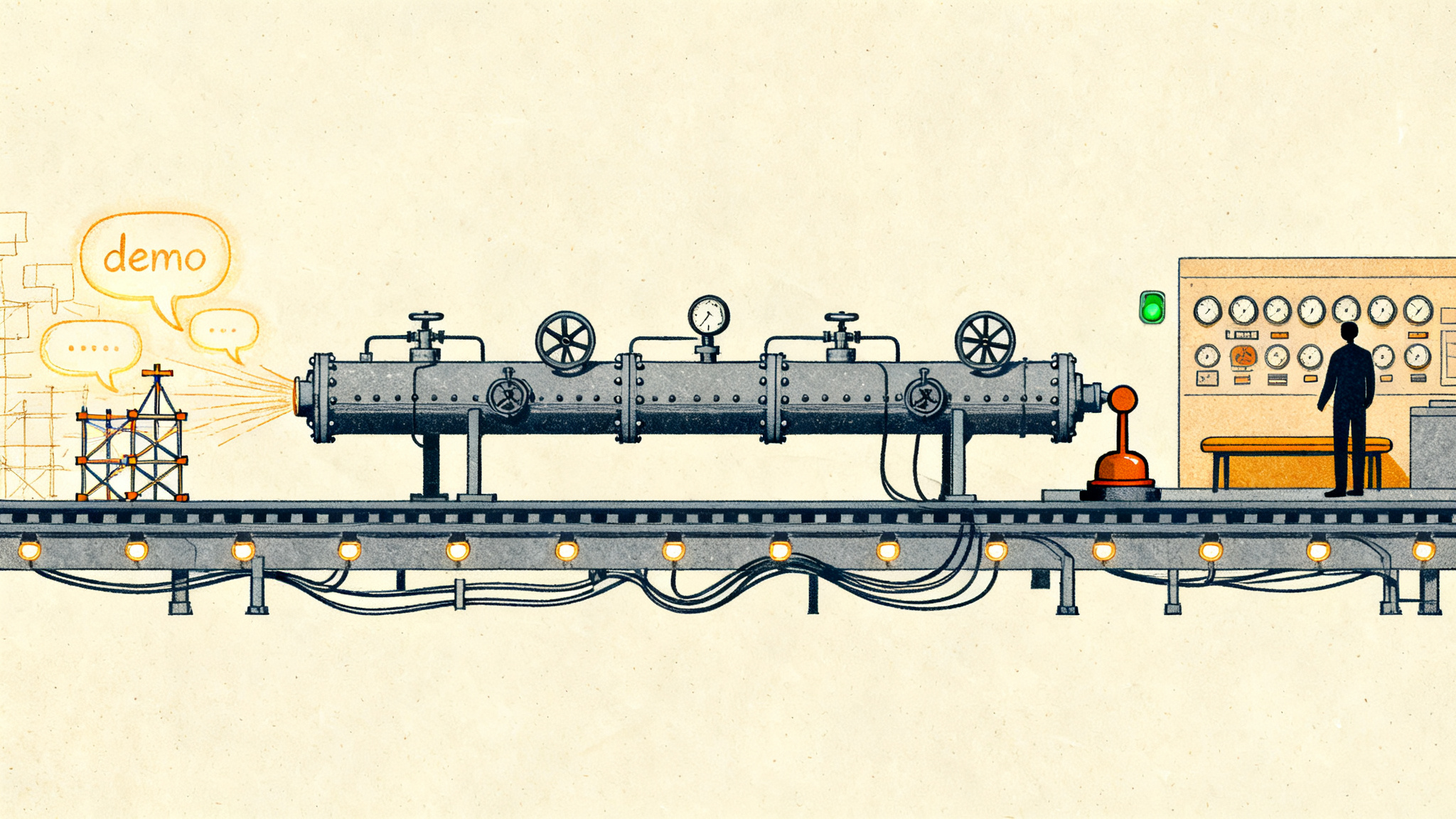
Open-source AI agent frameworks have quietly turned into infrastructure, and the proof isn't in anyone's marketing copy.
It's in version numbers and shell commands. Microsoft Agent Framework landed at 1.0 GA advertising "graph-based workflows, multi-agent orchestration, and human-in-the-loop support" (Microsoft agent resources). Read that back. Nobody puts "human-in-the-loop support" in a 1.0 GA description to win a hackathon.
That line exists because somebody expects this thing near a real workflow.
The prompt trick stopped being the interesting part a while ago.
What's interesting now is production commands, background daemons, dashboards. The plumbing. And the plumbing is showing up in READMEs instead of roadmaps.
Three projects make the case by themselves.
Microsoft Agent Framework: Open-Source AI Agent Frameworks Hit 1.0 GA
Microsoft's own timeline squeezes the whole category's story into a few short years.
September 2023: AutoGen ships, described as "a flexible and open-source Python-based framework for defining, configuring.
And composing AI agents to drive multi-agent applications" (Microsoft Research). June 17, 2024: AutoGen Studio appears, "a low-code interface for rapidly building, testing. And sharing multi-agent solutions," and it launches at version 0.1.0. That number's doing honest work.
A lab tool with a UI bolted on, and everyone involved knew it.
Now the same company calls Agent Framework "an open, multi-language framework for building production-grade AI agents and multi-agent workflows" in .NET and Python, offering "a consistent foundation for building, orchestrating. And operating agent systems across Python, .NET and Go" (GitHub). It's a "production-ready SDK for .NET and Python," and the supported list runs through Microsoft Foundry, Azure OpenAI, OpenAI. And the GitHub Copilot SDK.
Two things in that paragraph actually matter.
Multi-language support means your shop's existing language survives the adoption decision.
That's rare here. Most tools pick a language for you and make it your problem.
And "human-in-the-loop support" sitting in a 1.0 GA description is the single most important line item, since an agent a human can interrupt is an agent you're allowed to put in front of a client. The tradeoff is the services list. It's an Azure-shaped world, and if your stack lives elsewhere, that list is your exit interview. Read it before you commit. Not after.
OpenAgents and LiveKit: The Operational Tells
Two more projects, same signal, different angles.
OpenAgents pitches "One workspace where all your AI agents collaborate," then gets to the point in four words: "Open source. No account required." The launcher installs with a one-line shell command on macOS and Linux, or PowerShell on Windows. Running it. The command is `agn`. Opens "the interactive dashboard for managing AI coding agents" (GitHub).
So what's the dashboard for? The project says it can "Install runtimes, configure API keys, connect to workspaces. And keep agents running as a background daemon." That isn't agent composition. That's process supervision, and it's the part of agent work that quietly eats small teams alive.
Here's a question worth sitting with.
Would you notice within the hour if your agent daemon died overnight? Probably not. You'd notice when a client asked where the output went. A project that treats runtime installation, key configuration. And daemon supervision as first-class features understands the actual job. And "No account required" belongs in the same bucket — there's no vendor portal standing between you and your own logs.
That's supposed to be the point of open source.
LiveKit Agents takes a narrower swing. It's "designed for building realtime, programmable participants that run on servers" (GitHub), which tells you deployment is the target, not notebooks. But the real tell is the command structure. Development runs with `python myagent.py dev`. Production runs with `python myagent.py start`, which the project says "Runs the agent with production-ready optimizations." The repo also states plainly, "This project uses uv for package management."
A repair manual that walks you through disassembly in loving detail and then says "reassembly is similar" — that's what most framework READMEs feel like.
The dev command is the disassembly.
Production is the part that wrecks your week. A separate production entry point costs a maintainer almost nothing to document, and most still don't bother.
LiveKit did, and that kind of care tends to show up in the rest of a codebase.
The uv note, meanwhile, is a small reminder that the ground is still moving: your dependency manager is now part of framework selection whether you budgeted for it or not.
How to Choose an Open-Source AI Agent Framework
Cheat sheet first, screening list second.
| Framework | Language | Production command | Account required | |---|---|---|---| | Microsoft Agent Framework | .NET and Python | 1.0 GA, "production-ready SDK" | Framework is open source; services list skews Azure | | OpenAgents | Launcher app (`agn`) on macOS, Linux, Windows | Agents run as a background daemon | "No account required" | | LiveKit Agents | Python | `python myagent.py start` | Not stated in the README |
The screening list, built from what these three get right:
- Demand a production entry point. If the README stops at a dev command and there's nothing like `python myagent.py start`, you're evaluating a prototype, whatever the landing page claims. Budget accordingly. - Treat human-in-the-loop as the billing line. Microsoft put it in the 1.0 GA description for a reason. Unattended agents make great demos and terrible invoices. - Read the supported-services list before the feature list. Microsoft Agent Framework supports Microsoft Foundry, Azure OpenAI, OpenAI, and the GitHub Copilot SDK — a strength inside Azure, a dependency conversation outside it. - Watch the version numbers. AutoGen Studio launched at 0.1.0 in June 2024, and 0.x software earns less trust than a 1.0 GA stamp. Nothing wrong with running 0.x. Just budget for churn instead of stability.
Now the contrarian take: don't pick a framework at all yet.
Pick a workflow you'd automate this quarter, run it through two of these projects. And keep the one whose failure mode you can live with. The frameworks are still consolidating.
Your knowledge of your own workflow isn't, and that's the asset that survives the rename.
FAQ: Open-Source AI Agent Frameworks
What is the best open-source AI agent framework?
There isn't one, and anyone who says otherwise is selling something. In the Azure world with multi-language needs, Microsoft Agent Framework at 1.0 GA is the safe pick. If your pain is keeping agents running, OpenAgents treats that as the product. Realtime participants on servers is LiveKit's exact pitch. Best depends on which problem you actually have.
Are open-source AI agent frameworks production-ready?
Some now say so in writing.
Microsoft calls Agent Framework a "production-ready SDK for .NET and Python" at 1.0 GA. And LiveKit's start command ships "production-ready optimizations." Keep the category's age in mind, though — AutoGen arrived in September 2023 and AutoGen Studio was sitting at 0.1.0 in June 2024. Production-ready is a claim you verify against your own workload, not a label you trust.
Do I need an account to run them?
OpenAgents is explicit: "No account required." The frameworks themselves are open source.
But check the services list before assuming you're clear.
Microsoft Agent Framework supports Microsoft Foundry, Azure OpenAI, OpenAI. And the GitHub Copilot SDK. So you'll likely end up holding a vendor account somewhere upstream even when the framework itself costs nothing.
What Open-Source Agent Frameworks Mean for Solo Developers
The emergence of general-purpose open-source agent frameworks changes your evaluation criteria more than your capabilities.
You could always glue an agent together with raw API calls.
What you couldn't do was choose between multiple projects all claiming production readiness.
And that makes selection discipline the actual skill now.
So here's the week-one move. Take the one agent task you keep doing by hand and audit it against three questions: does the tool have a production command, does it support human intervention. And can you run it without creating a vendor account? Microsoft Agent Framework at 1.0 GA, OpenAgents' daemon-first launcher, and LiveKit's dev/start split each pass at least two. Boring infrastructure is the goal, and this category finally produces it.
If you want a second pair of eyes on which one fits your pipeline before you sink a weekend into it, that's the work my shop does.
Comments ()