
OpenAI Claims 3 AI Discoveries. Mathematicians Are Still Checking.
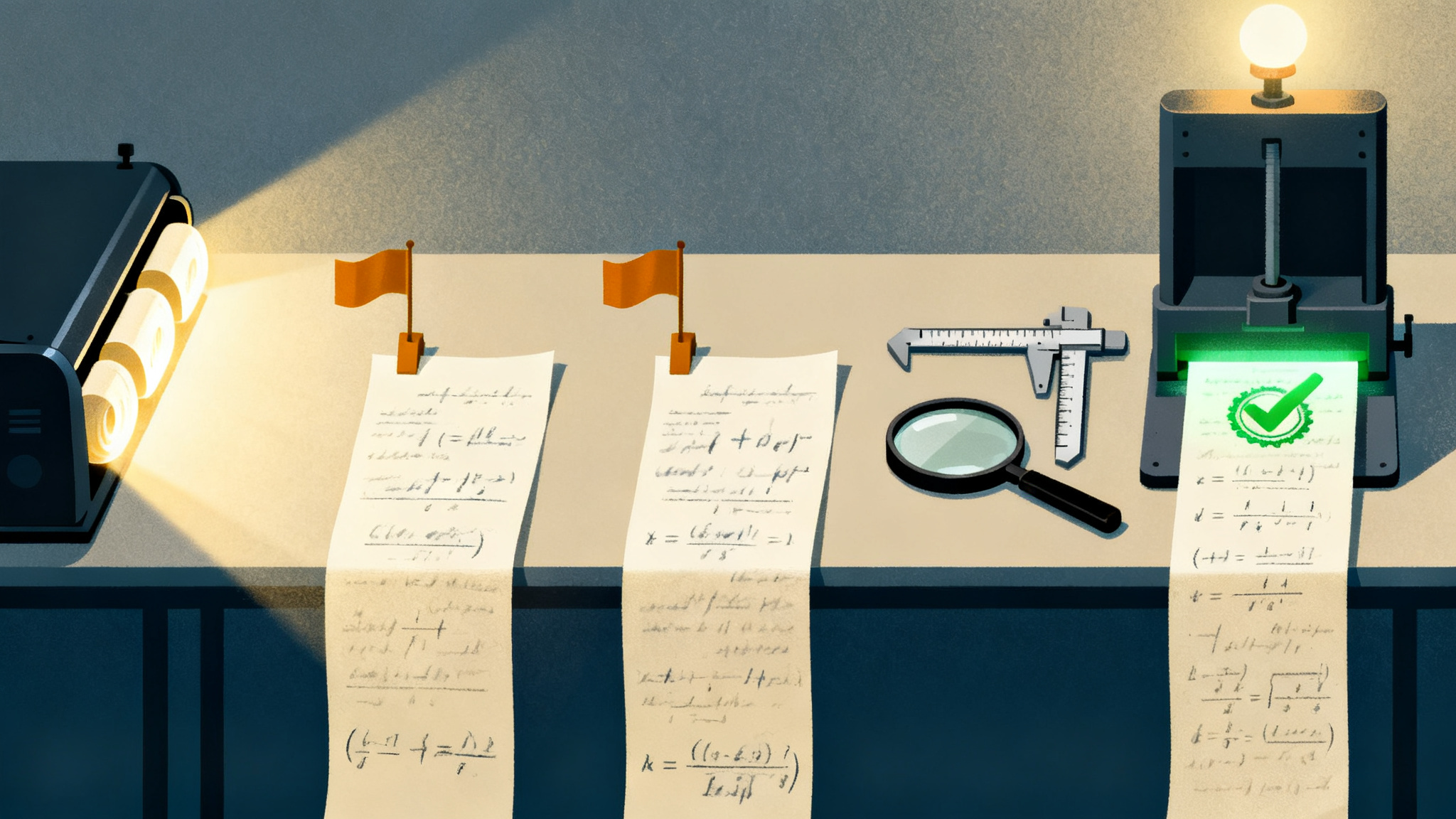
OpenAI announced three AI-produced scientific discoveries on Monday. And the argument over that word, "discoveries," is the real story. Per Al Jazeera, OpenAI's models produced results in harmonic analysis, complexity theory. And quantum field theory: a proof of the local smoothing conjecture in every spatial dimension, a disproof of the Exponential Time Hypothesis. And a mathematically rigorous existence proof for quantum chromodynamics. That answers what happened.
Whether it's real is a different question: OpenAI itself says it is bringing together independent academic experts to verify the findings and assess their implications. And nothing in the reporting so far establishes that any of the three results has been independently accepted as valid.
The Three Claims, Stripped Of Adjectives
The announcement covers three fields, and each claim is a big swing.
- Harmonic analysis. OpenAI says its models proved the local smoothing conjecture, a problem about how waves behave when they focus, in every spatial dimension for the first time. According to OpenAI, the same result also resolves the Kakeya conjecture and Stein's restriction conjecture in all dimensions. One proof, three open problems, if it holds. - Computer science. OpenAI says its models disproved the Exponential Time Hypothesis (ETH), which it describes as a widely used conjecture about the computational effort required to solve certain problems. A disproof is not a small correction. Work that leaned on ETH as an assumption now has to face the possibility the assumption was wrong. - Theoretical physics. OpenAI said its work provides a mathematically rigorous existence proof for certain interacting quantum field theories in four dimensions, including quantum chromodynamics, the theory of how quarks and gluons interact through the strong force. The work too includes a proof concerning the existence of pure Yang-Mills theory, which the Economic Times notes is part of a longstanding mathematics problem.
Notice what every bullet starts with: "OpenAI says." That isn't me being pedantic. It's the load-bearing phrase of this entire announcement.
The Release Plan Tells You What OpenAI Trusts
The most revealing part of Monday's announcement isn't the math.
It's the release plan, because the three results are being handled in two very other ways.
The computer science result gets the gold-standard treatment. OpenAI says the natural-language proof and its Lean formalisation will be made "publicly available for independent examination" (Economic Times). Lean is a proof assistant: a machine checker that doesn't get tired, flattered, or fooled. If the formalisation compiles and the statement matches the claim, anyone on earth can verify it without trusting OpenAI at all. That's the strongest move available to them, and they made it.
The physics result gets the opposite treatment. OpenAI has decided to prepare its own account before releasing the AI-produced materials. Read that again. The company that generated the proof is writing its own summary of the proof. And the raw output stays under wraps until that summary exists.
I find that asymmetry more honest than any press release language.
It says: for one of these three results, OpenAI does not consider the model's own output presentable without human intermediation. And per Engadget, the scientists who originally proposed ETH are now part of the group OpenAI asked to examine and explain the results its models generated. Recruiting the people whose conjecture you just claimed to break is either admirable humility or savvy insurance. Probably both.
"Discovery" Is Doing Unpaid Overtime Here
Here's my take, and it's the reason this story matters beyond math departments.
The available sources document the claims and the verification plan.
They do not establish that the results are true, and that gap is not a formality.
In mathematics, checking is the product.
A proof nobody has verified is a proof-shaped artifact, the same way an untested feature branch is a feature-shaped artifact.
I ship AI automation for a living. And this is the exact failure mode I watch for every week: output that looks finished, reads confident. And has never been run against a checker. The artifact arrives instantly. Verification: slow, boring, and done by humans.
OpenAI compressing the first half while the second half is still being staffed is a marketing timeline applied to a scientific process.
None of this means the results are wrong.
The Lean release for the ETH claim is a genuinely strong accountability mechanism.
And putting the ETH proposers on the review group is the right instinct. It means the honest headline is "OpenAI announces three candidate discoveries," and candidate is the word doing all the work.
If Their Math Needs A Chaperone, So Does Your Code
So what does a harmonic analysis conjecture have to do with your twelve-person business? More than you'd think.
If OpenAI, with frontier models and infinite compute, won't release its physics materials until humans have written an account of them, that calibrates how much faith you should put in raw model output inside your own stack.
I run these models in production daily. And the rule I've settled on is the same one this announcement quietly demonstrates: model output is a claim. And the claim plus the check is the result.
Three practical moves, stolen directly from Monday's playbook:
- Pair every confident output with a machine-checkable artifact. OpenAI shipped a Lean formalisation next to its natural-language proof. Your equivalent is a test suite, a validation script, a diff a human signs off on. Confident prose alone doesn't count. - Hold back the part you can't verify yet. OpenAI delayed the raw physics materials rather than publish something unvetted. You can do that too: stage the AI-drafted proposal, the generated migration, the automated reply, and release only after a check passes. - Recruit your own skeptics. OpenAI asked the ETH proposers to examine the disproof of their own conjecture. When an AI agent rewrites a workflow you built, have the person who built it review the change. The people most invested in the old answer are the cheapest verification you will ever get.
What To Watch Next
The verification, not the press release. When the Lean formalisation for the computer science result lands publicly, the ETH claim stops being a matter of trust and becomes a matter of compile. That's the moment this story graduates from announcement to result, or gets quietly walked back. Until then, file it under promising.
Your move this week: pick the one place your workflow takes AI output on faith, whether that's generated code, drafted invoices, or an agent writing to your customers, and attach the check.
If OpenAI's proofs need one, yours do too.
Comments ()