
OpenAI Cuts Cursor Off November 12. What Actually Breaks.
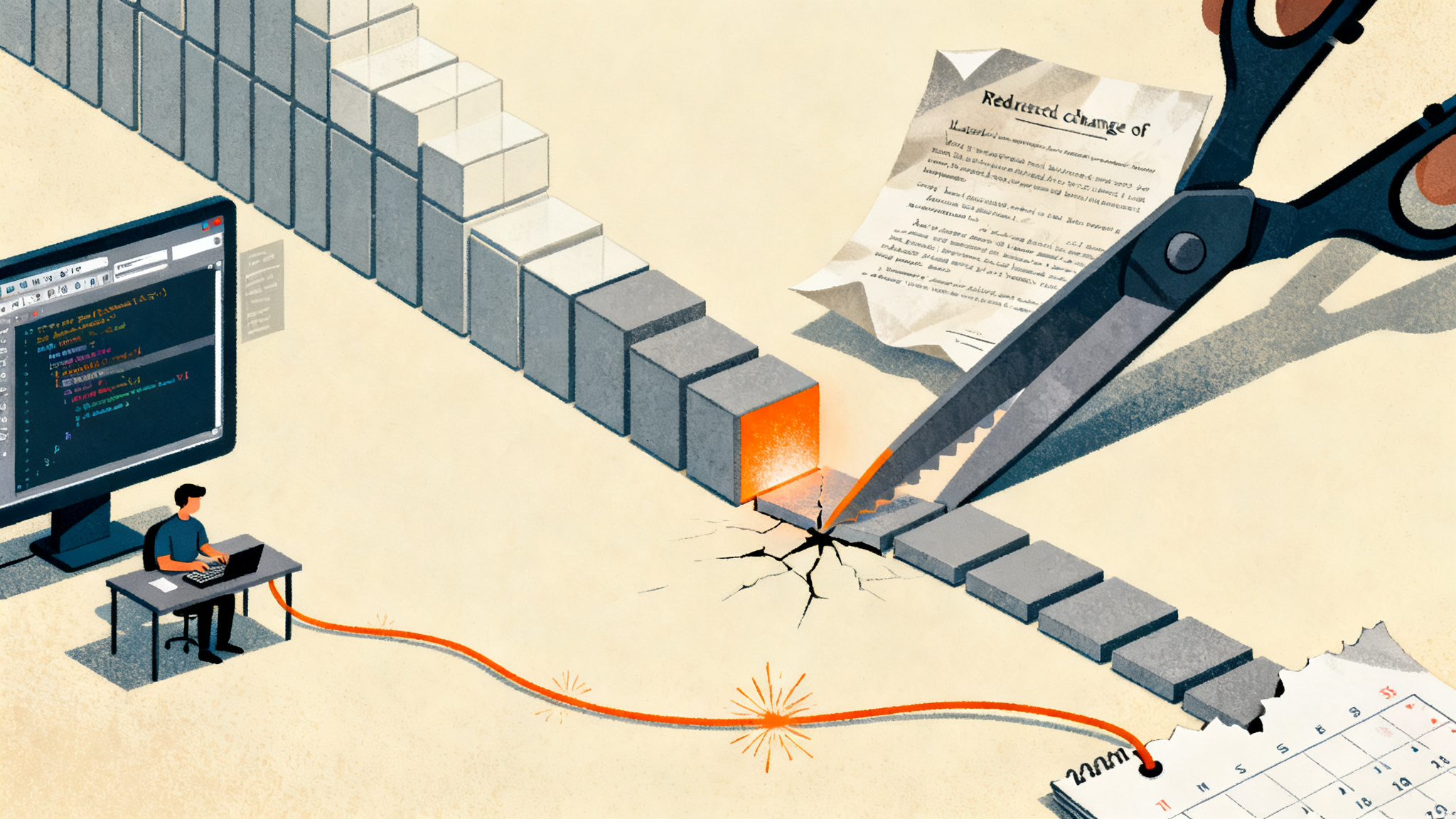
OpenAI is cutting Cursor off on November 12, 2026.
That is the proposed shutoff date in OpenAI's own announcement, "Our decision on Cursor following its acquisition by SpaceX," and the practical impact is narrower than the headlines suggest: after November 12, Cursor stops providing OpenAI models through its subscription, nothing gets erased from your machine. And you only need to act if you configured Cursor to use OpenAI models like GPT-4o or o3 or named those models in config files.
You can still run OpenAI models with your own API key, through OpenAI's Codex IDE extension, or through gateway providers, as Tom's Guide breaks down. CNBC, Reuters.
And Bloomberg all confirm the cutoff date.
I build AI automations for small businesses, and the deadline itself is not what got my attention. What got my attention is the mechanism: a change-of-control clause in a contract none of us signed just rewrote the model menu inside a tool developers open every day. That mechanism is now proven in public, and it will eventually reach a tool you actually depend on.
What OpenAI Announced, and How Fast It Moved
The announcement opens with the operational fact: "Today, we notified SpaceX that we intend to wind down our contract providing OpenAI models to Cursor, with a proposed shutoff date of November 12, 2026." The stated reason is blunter than corporate communications usually get. "We are making this choice because we cannot be confident that SpaceX will use our technology within our terms of service, based on our experience with Elon Musk's companies violating contracts."
The legal hook is a change-of-control clause. OpenAI writes that its "custom agreement with Cursor gives us a limited time window to cancel it after a change of control," and a Yahoo Finance analysis notes the clause was invoked on August 28, 2026. Two weeks before that, on August 14, SpaceX completed its $60 billion acquisition of Cursor, according to financial filings CNBC cites. Reuters frames the whole thing as an escalation of the Sam Altman and Elon Musk rivalry, which matches the tone of Musk's public response on X: he said he "couldn't care less" and called Sam Altman and Greg Brockman "utterly untrustworthy" people who "stole an open source nonprofit."
Two details keep the date honest. First, "proposed" is OpenAI's own word. And the company stresses it is giving "the maximum notice provided by our contract," so November 12 is the outer boundary of the wind-down, not a courtroom order. Second, OpenAI's documentation notes Cursor can end access sooner if it chooses, while Cursor's community forum says the company is still "speaking with the OpenAI team to resolve this." Treat the date as company-ish. And treat the reconciliation talk as unproven. Times of India pegs the partnership at around three years and a daily AI digest at nearly four. So call it a multi-year arrangement that got a two-week fuse.
What Actually Breaks on November 12 (and What Doesn't)
Start with scale, given that the coverage skips it. Cursor's own community forum says OpenAI models serve about 5% of total Cursor user traffic. The same thread says models from Anthropic, Google, Meta, and Grok continue through direct partnership in Cursor.
The typical Cursor user wakes up on November 13 to a slightly shorter model picker, not a broken editor.
| Ends after November 12, 2026 | Keeps working | | --- | --- | | OpenAI models bundled through Cursor's subscription | Anthropic, Google, Meta, and Grok models in Cursor | | Direct OpenAI-to-Cursor contract access | OpenAI models via your own API key | | Built-in OpenAI access under the old deal | OpenAI's Codex IDE extension and gateway providers |
OpenAI's help article "Using OpenAI models in Cursor" lists three main options, the first being "Stay in Cursor and switch models." Tom's Guide frames the OpenAI-specific paths as a personal API key, the Codex IDE extension, or gateway providers. OpenAI's support documentation also clarifies the models will not be "physically erased" from the app; what ends is the direct, built-in access under the contract.
So the action item is genuinely narrow. An Exodata explainer advises you only need to move if you specifically configured Cursor to use OpenAI models such as GPT-4o or o3, or named those models in configuration files. Everything else is status quo.
Model Access Is Now a Weapon. Plan Accordingly.
That same Yahoo Finance analysis describes the termination as a shift from collaborative AI development to using model access as an instrument of corporate competition. I think that is the correct read, and it matters far more than the deadline.
Change-of-control clauses are ordinary contract machinery.
What is new is watching one execute in public as a move in a founder feud. SpaceX bought a company on August 14. And two weeks later a primary model supplier invoked its exit clause, citing distrust of the buyer by name. The stated grievance was not Cursor's product or its users; it was the new owner.
The uncomfortable part for anyone running a lean operation is that your stack inherits disputes between people you have never met. The model behind your automation is a dependency, same as your payment processor, except the contract governing it sits between two giants and you are not a party to it. I do not say that to be gloomy; I say it as it is now a documented behavior pattern, and patterns repeat.
What I'd Do Before November 12
- Grep your configs. Search Cursor settings and project config files for GPT-4o and o3 references. Those pins are what actually break, per Exodata's guidance. - Pick your lane early. Stay in Cursor on Anthropic, Google, Meta, or Grok models, bring your own OpenAI API key, or move to the Codex IDE extension or a gateway provider. - Test the fallback this week. Model behavior differs enough that a swap done under deadline pressure produces worse code reviews than a swap done calmly. - Size the response to the blast radius. With OpenAI at roughly 5% of Cursor traffic per Cursor's own forum, rebuilding your whole environment is overkill for most people.
My standing rule after years of watching vendors change terms on short notice: never ship a client workflow that assumes one model vendor stays friendly.
Keep model names isolated in a single config layer, keep a tested fallback behind them. And document which automations break if a menu shrinks. That discipline costs an afternoon and buys you immunity from the next clause invocation.
The Deadline Is Small. The Pattern Isn't.
November 12 will pass quietly for most Cursor users.
The pattern behind it will not pass quietly at all, since every tool that bundles someone else's models is one acquisition or one feud away from a shorter menu. And the clause that does the trimming was written without you in the room.
You cannot control M&A between giants. You can control whether your workflows survive it. And that control comes from treating model access as replaceable infrastructure rather than a brand loyalty. If you want a second set of eyes on where your automations quietly depend on a single vendor, that is exactly the work Mediascout does. Get in touch, and we will map your exposure before somebody else's contract does it for you.
Comments ()