
Research Skills for AI Coding Agents That Hold Up
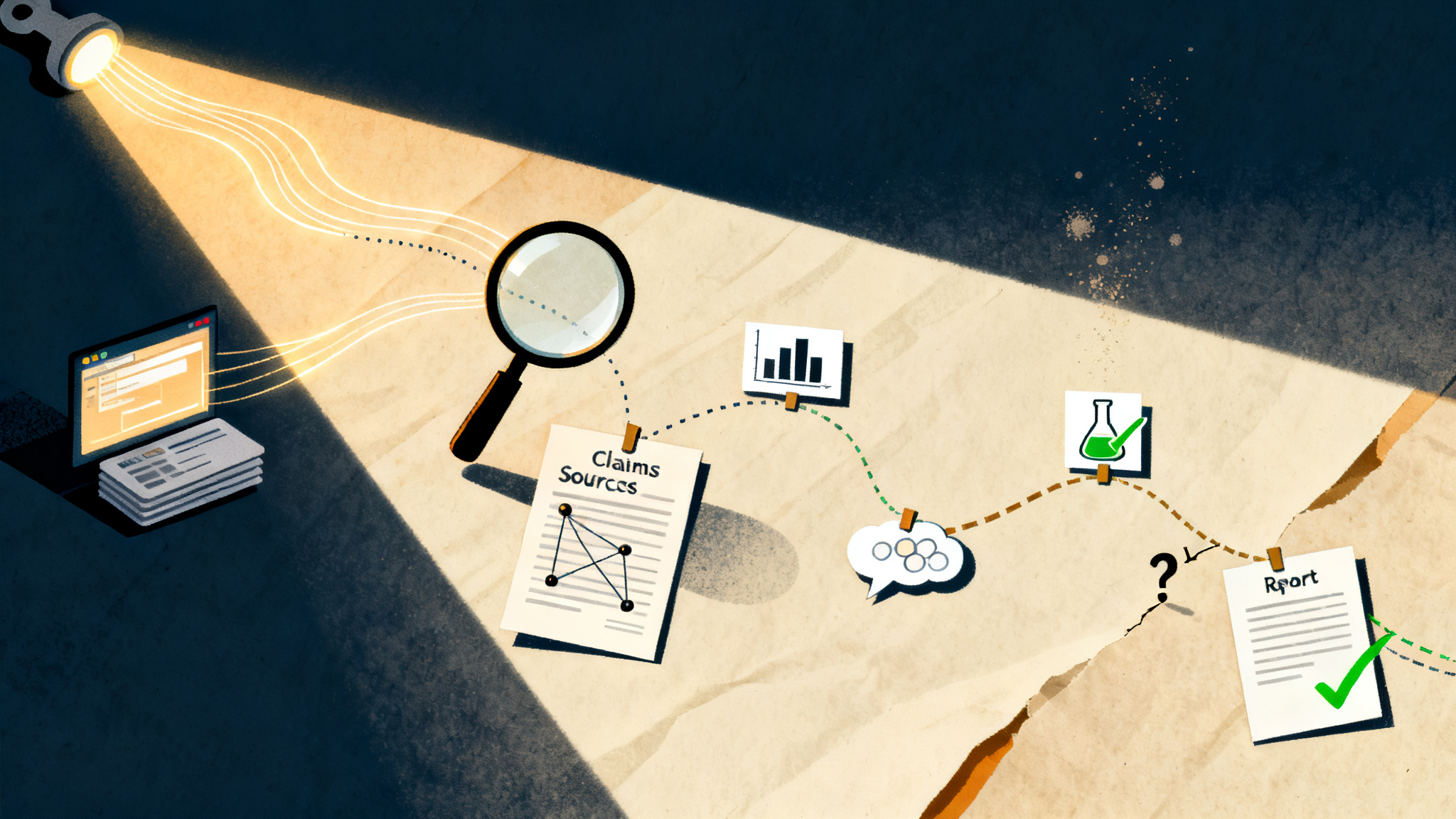
Research skills for AI coding agents face 113 original tasks in DeepSWE.
That matters because a coding agent cannot be trusted merely since it produces a polished answer or a repository that looks complete. The useful skill is the one that gathers evidence across public communities, preserves where each claim came from, tests the result. And exposes what remains unresolved.
That is the difference between asking an agent to “research this” and giving it a repeatable research workflow. The first produces a summary. The second gives you a trail you can inspect before you build around it.
Coding agents need research loops, not better summaries
ResearchClawBench measures whether AI coding agents can conduct scientific research independently, starting with raw data and ending with publication-quality reports.
It evaluates those results against real human-authored papers, which sets a higher bar than producing plausible prose. (ResearchClawBench)
That same standard applies to practical software research.
If I ask an agent whether a library, model, or implementation approach is worth using, I do not only need its conclusion. I need to know which sources it checked, whether those sources agree, what evidence supports the recommendation. And where the answer is still thin.
Cross-community research skills matter given that useful technical evidence is scattered.
A project repository may show what a tool claims to do. A discussion community may reveal where it fails. A benchmark may show a measured result.
None of those sources should silently stand in for the others.
The agent's job is not to flatten those differences into one confident paragraph. Its job is to keep them visible.
The benchmark pattern shows what to measure
ProjDevBench evaluates coding agents on end-to-end project development.
It gives agents project requirements and evaluates the repositories they produce. The benchmark covers system-architecture design, functional correctness. And iterative solution refinement, combining Online Judge testing with LLM-assisted code review. (ProjDevBench)
That structure offers a practical model for research skills. A useful workflow should have separate checks for:
- Source collection: Did the agent find relevant material from more than one public source? - Evidence matching: Does each conclusion match the source that supposedly supports it? - Technical verification: Can the agent test the implementation, reproduce the result, or inspect the underlying artifact? - Revision: Does it change its conclusion when a source contradicts the first answer? - Output quality: Can you read the final report and trace its important claims?
PRDBench takes a similar approach with 50 real-world coding tasks across 20 domains. Each task includes a structured Product Requirement Document, comprehensive evaluation criteria, and a standard solution code repository. Its evaluation uses agent-driven annotation to score code beyond unit tests. (PRDBench)
My take is simple: a research skill should be judged like code. You do not approve a pull request as the diff sounds reasonable. You inspect the change, run checks, and look at the parts most likely to fail. Research needs the same treatment.
Community signals are evidence, not verdicts
A community can surface information that formal documentation misses.
A separate guide describes r/LocalLLaMA as a place where people discuss benchmarks, quantization trade-offs. And VRAM calculations after new open-weight model releases. (AI Builder Club)
That makes community research useful, but it does not make every comment reliable.
The signal is the beginning of an investigation, not the conclusion.
An agent that copies the most repeated opinion from a discussion thread has not performed research. It has counted agreement without checking the claim.
A better skill should record the role of each source:
- A benchmark can support a measured comparison. - A repository can support the existence of an implementation. - A discussion can reveal a failure mode or a user experience. - A technical report can explain the method behind a result. - A test run can confirm whether the claim holds in your own environment.
Those categories should not be merged. If a community discussion says a tool is difficult to configure, the report should present that as community evidence. If a benchmark tests a defined task, the report can describe what that benchmark measured. The distinction protects you from turning a useful warning into a universal claim.
This is especially real for a small operator.
You do not have time to verify every tool by building a full evaluation system.
But you also cannot afford to make a product decision from an untraceable summary. A research skill should reduce that tradeoff by showing you where to spend your limited attention.
The same research skill should expose its work
A study comparing AI coding agents analyzed 7,156 pull requests from the AIDev dataset and compared OpenAI Codex, GitHub Copilot, Devin, Cursor. And Claude Code. (arXiv) That kind of comparison is useful since it defines the agents and the evidence under review instead of treating “coding agents” as one undifferentiated category.
DeepSWE goes further on inspectability. It contains 113 original, long-horizon software-engineering tasks and releases the benchmark, its verifiers. And the full record of evaluation trajectories so people can inspect the behavior behind the results. (DeepSWE)
That should be the standard for cross-community research skills.
The final answer is only one layer.
The skill should too leave behind:
- The sources it found. - The claims extracted from each source. - The conflicts between sources. - The checks it performed. - The evidence it could not verify. - The reason it reached its final recommendation.
Without that record, you cannot tell whether the agent researched the question or simply produced a familiar answer.
A clean report can hide a weak process. An exposed process gives you something to audit.
The community-built research skills described in a Reddit post point toward this repeatable approach. Their stated purpose was to help a coding agent configure and use Megatron-LM, TRL. And vLLM, while reducing repeated instructions for AI research experiments. (Reddit)
The key idea is not the list of tools.
It is the reusable instruction layer. If you keep teaching an agent the same research procedure, that procedure belongs in a skill.
Then you can improve the checks instead of rewriting the request.
Build the smallest research skill you will inspect
Do not start by asking an agent to monitor every community or summarize every discussion.
Start with one decision you actually need to make. Define the sources it may use, the claims it must support, the tests it must run. And the format of the evidence trail.
For a small business or solo project, the first version can be narrow:
1. Ask the agent to collect primary documentation and relevant community reports. 2. Require a source link beside every material claim. 3. Separate measured results from user reports and agent interpretation. 4. Ask it to list contradictions instead of resolving them silently. 5. Require a short “what would change this conclusion” section. 6. Review the evidence trail before acting on the recommendation.
This is less exciting than installing a large collection of skills.
It is more useful.
The goal is not to make the agent sound like a researcher.
Goal: to make its work inspectable enough that you can catch a bad recommendation before it becomes code, spending, or customer-facing behavior.
Cross-community research skills for AI coding agents will earn their place through this discipline.
The winning skill is not the one that produces the longest report.
It is the one that makes the path from scattered evidence to shipped decision clear enough for you to challenge.
Build one research loop around a real decision, require the sources and unresolved claims to remain visible. And inspect the output before your agent writes the next line of production code.
Comments ()