
Seventy-Five Things Called Copilot. One Keyboard Key. No Pattern.
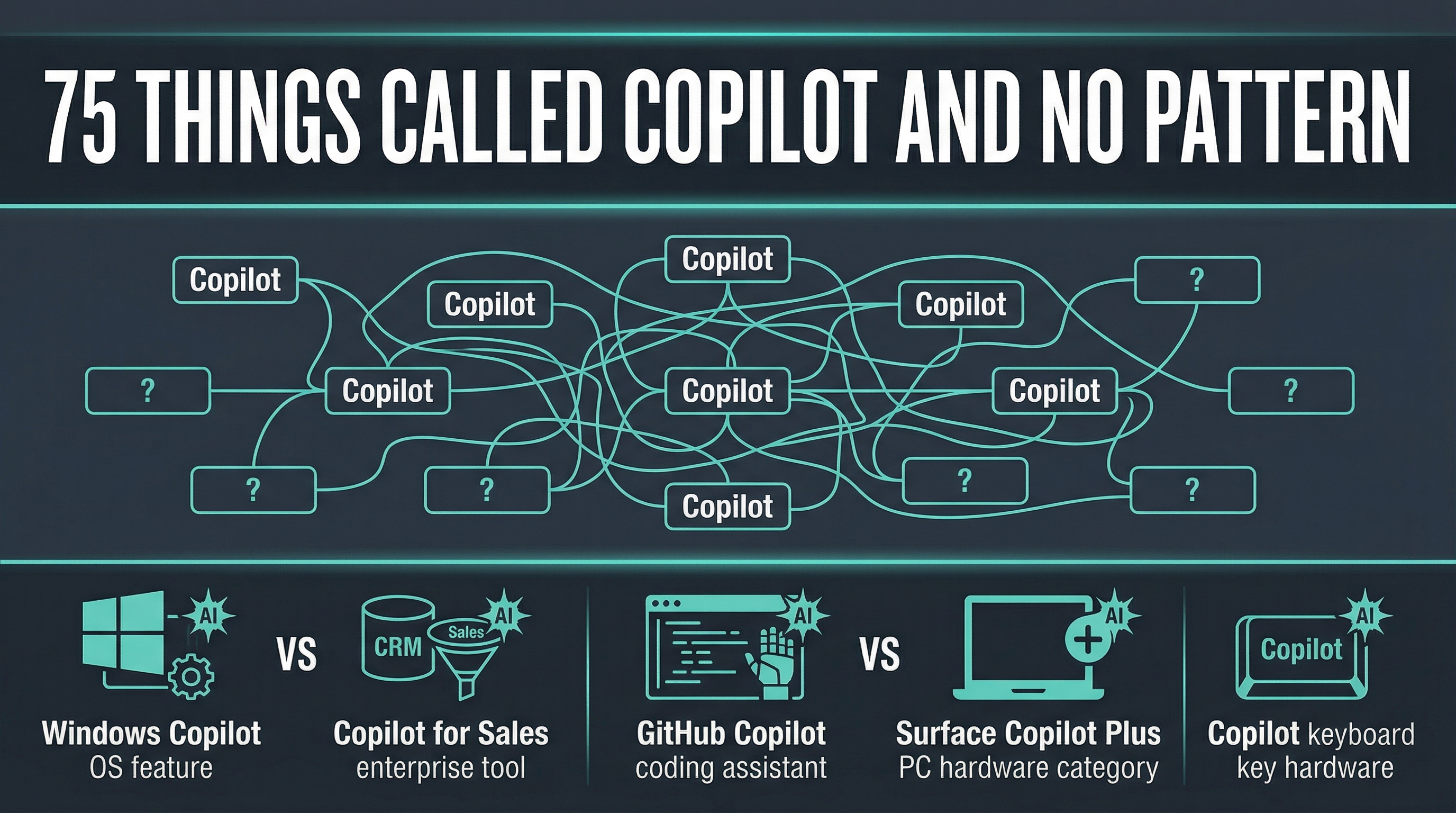
Someone tried to explain Microsoft Copilot to a colleague last week. They couldn't do it. Not because they did not understand it, but because Copilot now refers to apps, features, platforms, a keyboard key, an entire category of laptops, and a tool for building more Copilots. All of them. The same word.
They decided to count. Seventy-five and counting. No single source, including Microsoft's own website, had a complete list. They had to build the map themselves.
The visualization is worth a look. It maps how the products connect. The author admits in the piece: "Try to find a pattern. I couldn't."
What 75 Products Actually Looks Like
Windows has Copilot. Microsoft 365 has Copilot. Edge has Copilot. GitHub has Copilot. There is Copilot for Service and Copilot for Sales. Copilot Studio builds bots. Surface Copilot Plus PCs are a hardware category. New keyboards have a dedicated Copilot key.
That is not even half.
The full list includes integrations across Dynamics, Power Platform, Azure, Viva, Security, and more. Each team at Microsoft that shipped an AI feature appears to have added Copilot to the name. The result is a product family that has no coherent identity from the outside.
The GitHub Copilot story is the most instructive. That product started as a beloved coding assistant with a clear value proposition and a dedicated user base. When it got absorbed into the Microsoft Copilot umbrella, something got lost. The brand GitHub had built became harder to distinguish from an OS feature and a hardware category.
The Community Is Not Letting This Go
The HN thread has been running for days and the comments keep coming. People are sharing their own Microsoft product confusion stories. One commenter thought Copilot in Edge was a VPN service. Another spent twenty minutes trying to figure out which Copilot they actually needed for their enterprise tenant. A third described buying a Copilot Plus PC and not being able to find the Copilot they had paid for.
These are not edge cases. They are the expected result of branding seventy-five distinct products with one name. Differentiation requires that buyers understand what they are buying. When every product shares a name, the buyer cannot make that distinction without doing research that defeats the purpose of having a consumer-facing brand.
What This Tells Us About AI Washing
Microsoft is not alone in this. The broader tech industry has spent the last two years slapping AI descriptors on everything. When every product is AI-powered, the AI descriptor stops carrying meaning. Microsoft Copilot is the most visible example because of the scale, but the same dynamic plays out in every software category.
The cost is real. Buyers tune out. Product teams lose the ability to communicate distinct value propositions. And the brands that spent years building recognition end up with a name that means everything and therefore means nothing.
Seventy-five products. One keyboard key. No coherent pattern. The visualization is worth a look, if only to confirm that the problem is exactly as bad as it feels.
Sources: - Tye Bannerman — How Many Microsoft Copilots Are There? - Hacker News Discussion