
SpaceX Is Buying Cursor and That Changes Everything
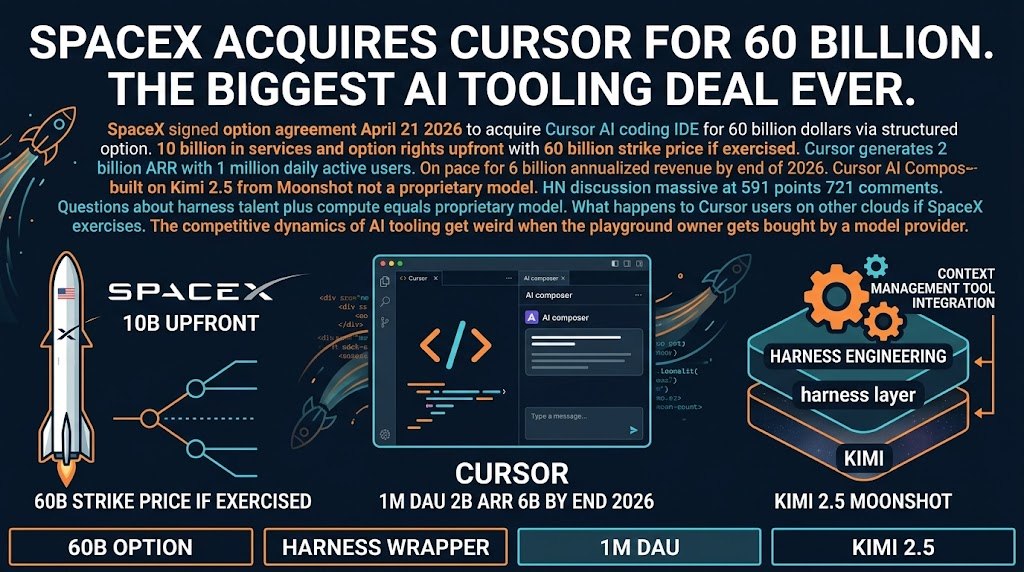
$60 billion. That's what SpaceX agreed to pay for Cursor, the AI coding IDE you've probably been using if you're doing any serious AI-assisted development. The deal structure is $10 billion upfront for services and option rights, with a $60 billion strike price if SpaceX exercises. Cursor is doing roughly $2 billion ARR with 1 million daily active users, on pace for $6 billion annualized revenue by end of year. The headline number sounds insane until you do the math.
Here's the part nobody is talking about enough yet.
Cursor is a really good harness. It's not a model company. The AI Composer that makes Cursor feel magical runs on Kimi 2.5 from Moonshot, not a proprietary model. You're paying $100/month for UX, context engineering, and file access patterns, not for the underlying AI. That's a fundamentally different product than what most people think they're buying.
Why the $60B Price Tag Might Make More Sense Than You Think
Yes, $60B is a lot for a company whose main AI feature runs on someone else's model. But the HN thread surfaced something interesting that changes the calculation. Harness engineering decisions don't just influence UX, they influence how frontier models get trained. When a million developers use a specific context management pattern, file access pattern, and tool integration approach, that behavioral data flows back into what gets optimized next.
A good harness isn't just a pretty interface. It's a feedback loop into the model's development. SpaceX isn't just buying a user interface. They're buying a behavioral data pipeline and the talent that built it.
If Cursor gets access to SpaceX compute, it could begin pretraining its own foundation model. That's a different company. The $60B strike price is a bet that the compute + the talent + the behavioral data = a defensible model business. Whether that bet pays off is another question. But the logic isn't completely insane.
The Real Question for Agencies and Solo Operators
Here's the thing that should matter to you.
If you're building client workflows around Cursor, you're building on a tool that might not be platform-independent much longer. SpaceX owns xAI. XAI competes with OpenAI and Anthropic. Cursor's Composer currently runs Kimi and also integrates with OpenAI and Anthropic models. If SpaceX exercises the option and Cursor becomes an xAI shop, what happens to the OpenAI and Anthropic integrations?
The competitive dynamics get weird when the playground owner gets bought by a model provider. OpenAI keeps giving Cursor preferential API pricing while competing for the same users? Anthropic keeps offering Claude Code as an alternative while SpaceX/xAI controls Cursor's roadmap? That tension doesn't resolve cleanly.
You probably don't need to drop Cursor today. The option probably won't exercise for a while, if ever. But this is a reminder that your AI tooling choices have strategic implications. Tools with deep integrations into specific model providers carry switching costs that aren't obvious until the acquisition announcement drops.
What You Should Actually Do About It
Three things, in order.
First, if you're using Cursor for client work, audit your workflows for platform dependencies. Where does it call your files, where does it store context, what credentials does it have access to? The answer is probably "everything" because that's what makes it useful. That's also the risk.
Second, build exit ramps into your AI tooling stack. The Claude Code removal story, the agents-going-async story, the Cursor acquisition story. The tooling layer is consolidating around model companies fast. Pick tools that give you portability or at least know what you'd need to rebuild if your primary tool gets acquired or changes direction.
Third, watch the option exercise timeline. $10B in services and option rights is a big commitment but not the same as a full acquisition. If SpaceX exercises, the competitive dynamics of AI tooling change on day one. If they don't, Cursor remains independent and you keep your optionality.
The Cursor acquisition is a signal, not an anomaly. The model companies are buying the harness layer because the behavioral data and UX control matter more than most people thought. That's worth knowing before you commit your workflows to any single tool.
Sources: HN Discussion | Reuters | NY Times
Comments ()