
The Doctor Who Loved AI Scribes - And Why He Stopped
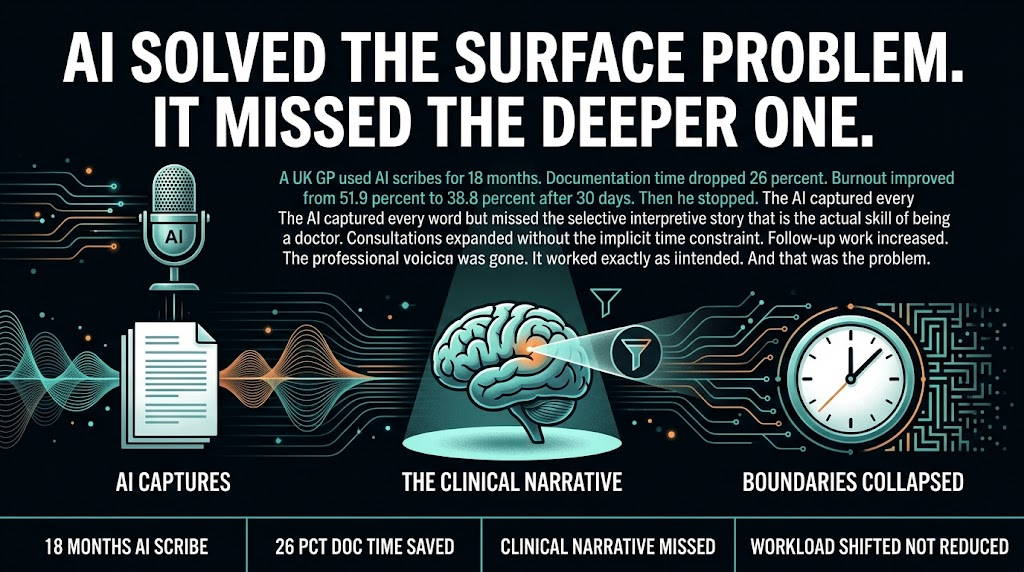
A UK GP used an ambient AI scribe every day for 18 months. Initial data looked great: 26% time saved on documentation, burnout dropped from 51.9% to 38.8% after 30 days. He was a true believer. Then he stopped. Not because the technology failed. Because it worked exactly as intended, and that revealed the problem.
This story is trending on HN today. It deserves more than a thread.
If you get paid for expertise, this story should make you uncomfortable.
More Data Is Not Better Judgment
The GP's insight is simple and devastating.
AI scribes record every word. They are too comprehensive. The actual skill of being a doctor is not capturing everything. It is deciding what matters. It is constructing the "clinical narrative" — the selective, interpretive story about what the patient said, what worried the doctor, what to watch and why.
That curation is not administrative drag. It is the professional judgment that justifies the title. The AI was too good at removing the friction. It removed the thinking along with the paperwork.
The Workload Did Not Decrease. It Shifted.
The documentation time dropped 26%. That was real. The burnout numbers looked good at 30 days.
But after 18 months, the GP noticed something the 30-day metrics did not capture. The implicit 10-minute contract that normally constrains consultations dissolved. When the doctor is not writing notes during the appointment, the appointment expands to fill whatever space the patient needs. The consultations got longer. The follow-up work at the end of already-overflowing days got heavier. The loose threads multiplied.
The administrative burden did not vanish. It moved downstream. The GP was doing more follow-up work because the AI had freed him to take on more problems during appointments without the natural constraint of having to document them himself.
What You're Delegating When You Delegate Documentation
Documentation is not drudge work. It is thinking made durable. When you dictate a note or write up an analysis, you are not just recording your thinking. You are doing your thinking. The friction of writing is often the same as the friction of deciding what matters.
AI scribes remove that friction. They look like productivity tools. They are actually judgment delegation tools. The question is not whether the technology works. The question is what you are giving up when you stop doing that work yourself.
For consultants, agency operators, anyone who gets paid for expertise: before you automate your documentation, know what you are automating along with it. The clinical narrative a GP constructs during a consultation is not separate from the care. It is the care. Remove the construction and you have more data and less judgment.
The GP's conclusion is worth quoting directly. The AI scribe succeeded at its stated goal. The goal was the wrong goal. It solved a surface problem while undermining the deeper cognitive work that makes the expert effective.
That is the risk of building on AI productivity tools without asking what those tools are actually replacing. The replacement might be the point.
Sources: - Benn Gooch — I Was an Enthusiastic Early Adopter - Hacker News Discussion
Comments ()