
The Jepsen Guy Wrote an Essay About Why AI Is Weird. Everyone Should Read It.
Kyle Kingsley is the distributed systems researcher behind Jepsen. If you have ever run database correctness tests, you know that name. He spends his time finding the edge cases where your database lies to you. He published a new essay series today and it is the most substantive pushback against AI boosterism that has hit HN this week.
The title is "The Future of Everything is Lies, I Guess." The argument underneath it is worth engaging with honestly.
What He Is Actually Saying
Kingsley's framing for LLMs is blunt. He calls them giant piles of linear algebra predicting statistically likely token completions. No understanding. No goals. No internal state driving behavior. The word "intelligence" in the context of these systems is, in his argument, marketing masquerading as a technology description.
That is a polemic. It is also a correct description of what the math does. An LLM does not know what it is saying. It predicts what tokens should follow other tokens based on statistical patterns in training data. That does not mean it is useless. It means the word "AI" is doing a lot of work it should not be doing.
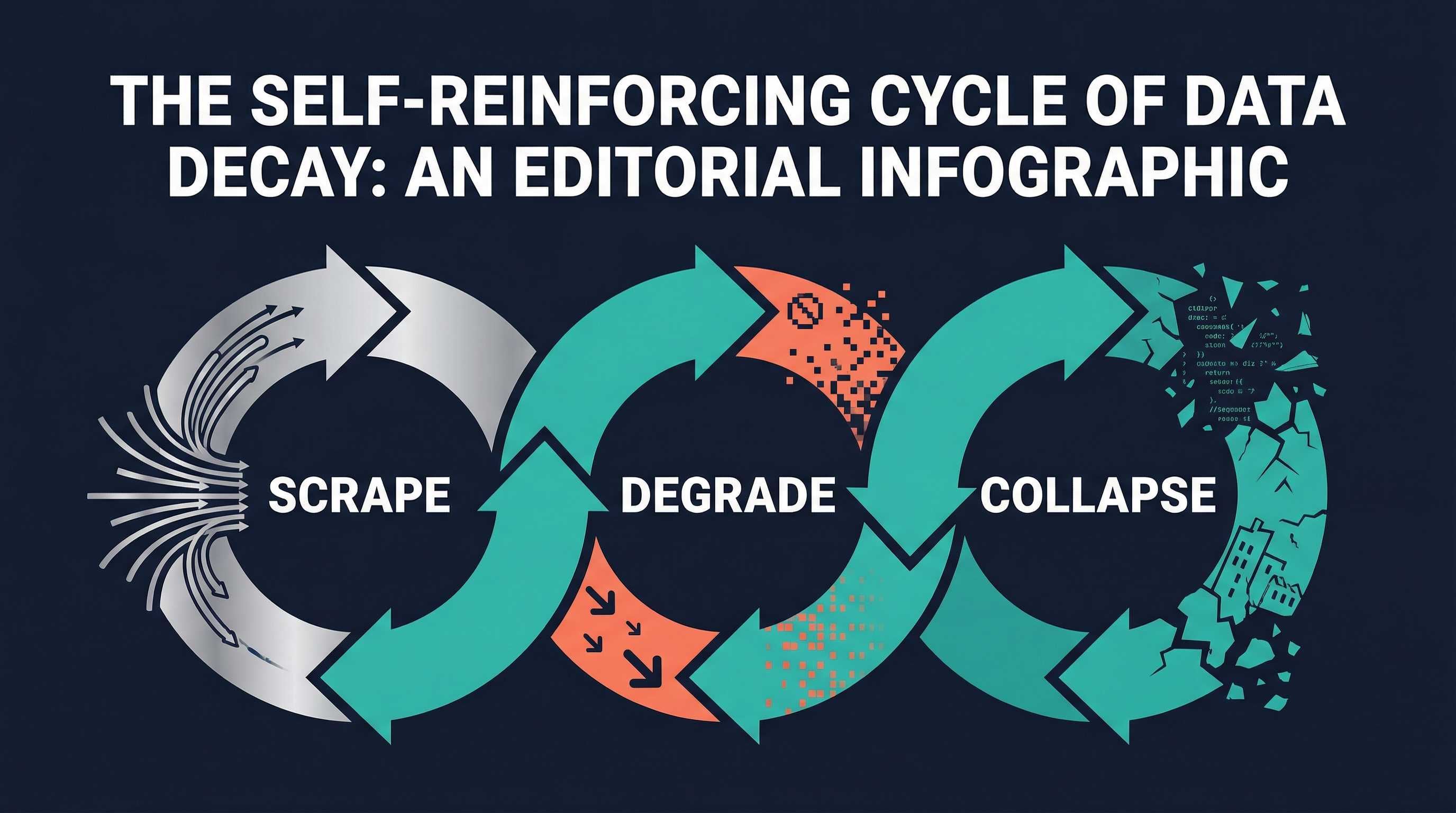
The essay series traces a mechanism he calls the collapse feedback loop. AI systems scrape the human-generated internet at industrial scale. They compete with the humans they scraped. The humans they scraped start producing less content, or lower quality content, because the economic incentive to produce original work erodes when AI can replicate it at scale. The training data degrades. The models degrade. The output degrades. The commons that the entire system depends on gets stripped bare.
He draws a direct parallel to the Industrial Revolution. We stripped the natural environment to fuel production. We are now stripping the digital commons to fuel AI training. The analogy is not subtle, but it lands because it is accurate.
The Copyright Problem as Enclosure
The essay reframes the AI copyright debate as a commons enclosure problem. A single corporation can train on copyrighted work and profit from the knowledge indefinitely. The creator receives nothing. The knowledge gets absorbed into a product that competes with the creator's own work.
Historically, enclosure of common land was controversial precisely because it transferred value from shared resources to private owners while the people who had used that land lost access. Kingsley's argument is that AI training on human-generated content without compensation is the same move in digital form.
The HN comment section has been turning this into the best discussion of AI and intellectual property we have seen in months. People with legal backgrounds, economics backgrounds, and software engineering backgrounds are all engaging with the framing seriously.
Why This Essay Is Worth Your Time
If you have been watching the AI hype cycle with a feeling that the industry is promising something it cannot deliver, and you cannot articulate why that feeling is correct, this essay is for you.
It is not anti-AI. Kingsley uses these systems. He is not arguing they do not work. He is arguing that the framing matters. When we call these systems intelligent, we stop asking what they actually are. We stop reasoning clearly about their risks. We stop noticing the feedback loops that are already degrading the information ecosystem they depend on.
The essay is deliberately imperfect. Kingsley says in the introduction that he has been sitting on this for years, refining and never finishing. His conclusion was that the perfect essay would never arrive, and he might as well publish something. The imperfect honesty is part of why it resonates. He is not claiming to have solved the problem. He is claiming to have thought carefully about it, and to have found the framing useful for understanding what is happening.
It is a long read. Ten chapters. PDF and EPUB formats that update as each section drops. Start with the introduction. Follow the links.
The conversation about what AI actually is and what it is doing to the information commons is not going away. This essay is one of the more rigorous entries in that conversation.
Sources: - Aphyr — The Future of Everything is Lies, I Guess - Essay PDF (updating as chapters drop) - Hacker News Discussion