
Three New Gemini Flash Models Ship. Flagship Pro Still Missing.
Key Takeaways
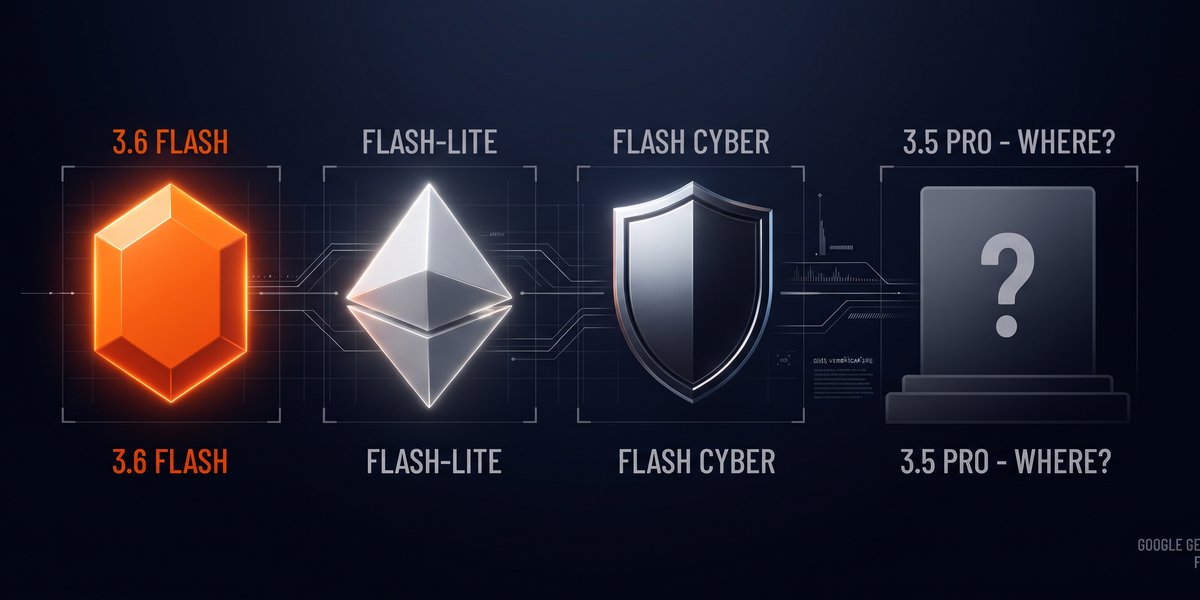
- Google shipped three Flash-tier models on July 21, 2026: Gemini 3.6 Flash, 3.5 Flash-Lite, and 3.5 Flash Cyber, all built for speed and cost efficiency over reasoning depth. - Gemini 3.6 Flash uses up to 17% fewer tokens and costs less per token than its predecessor, with both it and Flash-Lite generally available for production use in the Gemini API. - Gemini 3.5 Flash Cyber finds, validates, and patches software vulnerabilities, but access is locked to governments and trusted partners through Google's CodeMender pilot program. - Gemini 3.5 Pro, the flagship promised at I/O for June 2026, remains stuck in partner testing with no public release date.
Google dropped three new Gemini Flash models on July 21, 2026. And you can use two of them right now. Gemini 3.6 Flash and 3.5 Flash-Lite are generally available in the Gemini API for production workloads.
The third model, 3.5 Flash Cyber, is a vulnerability-hunting tool you can't access unless you work for a government or a selected security partner.
All three sit in what Google calls the Flash tier, tuned for speed, cost efficiency. And high-volume agentic work rather than maximum reasoning depth.
Translation: these are workhorse models, not deep-thinkers. Google frames the Flash series as built for "efficiency, low latency. And reliability" when you're running AI agents at scale.
But the real story isn't about three new models.
It's about the one that didn't show up.
Why Did Google Ship Budget Models While 3.5 Pro Disappeared?
Google shipped three Flash-tier models on July 21 while its flagship 3.5 Pro remains locked in partner testing two months past its promised release window. Google said at I/O on May 19, 2026 that 3.5 Pro was already running internally and would roll out "next month." That meant June 2026. June came and went. July came and went. Google now only says it will be available "as soon as it's ready."
Here's the kicker. Ars Technica reported that the earlier Gemini 3.5 Flash, which was "the star of the show at I/O," has now been deprecated. Gemini 3.6 Flash took its place in the lineup.
So Google swapped its popular mid-tier model and shipped two lighter variants while the flagship everyone actually wanted stays behind closed doors.
CNBC and other outlets frame the 3.5 Pro delay as part of a broader pattern of pipeline slippage. The delay is getting extra attention because Alphabet continues to commit heavily to AI infrastructure.
The company missed its own June timeline and hasn't given a new date.
My read: Google is playing the volume game.
Ship models that are cheap to run and easy to scale, let the flagship simmer. And bet that developers building production agents care more about token costs than benchmark scores. That bet works for enterprises running millions of API calls. For small operators like me, it means the model I want for complex reasoning work is indefinitely unavailable.
What Makes Gemini 3.6 Flash Worth Switching To?
Gemini 3.6 Flash uses up to 17% fewer tokens and costs less per token than the model it replaces, making it an immediate cost win for anyone running production agents. CNBC reports that the token reduction directly reduces the cost of running high-volume workloads. If you're running agentic workflows where each completed task involves dozens of model calls, that number matters.
Token consumption is the hidden tax on AI automation. And a model that burns fewer tokens per task without falling apart on quality drops your effective cost per task in a way that compounds across thousands of runs.
Google built 3.6 Flash directly from developer and customer feedback on 3.5 Flash.
The improvements target coding, multimodal. And knowledge-work performance. Google's developer documentation confirms that both Gemini 3.6 Flash and 3.5 Flash-Lite are generally available and ready for production use. The API identifier is `gemini-3.6-flash`, live in the same endpoints you already use.
But wait, there's a second model worth your time. 3.5 Flash-Lite targets faster, high-volume workloads. Google calls it the "fastest, most cost-effective 3.5-class model for high-volume workflows." It's also rolling out in Google Search, appearing in AI experiences including Search's AI Mode. When Google trusts a model enough to put it in Search, that tells you something about reliability at scale.
I haven't benchmarked 3.6 Flash myself yet.
My agency runs production pipelines on a mix of models depending on what each client needs. But a 17% token reduction on a model positioned as the default workhorse is worth testing this week. If you currently use any 3.5 Flash variant in production, the upgrade path is straightforward. The previous model is deprecated and the replacement is already GA.
Who Gets Gemini 3.5 Flash Cyber and Why Is It Locked?
Gemini 3.5 Flash Cyber is available only to governments and selected security partners through a restricted pilot. And you can't use it. Google and DeepMind built Flash Cyber as a lightweight cybersecurity model on top of 3.5 Flash, fine-tuned to find, validate, and patch software vulnerabilities quickly and efficiently. DeepMind states it's more effective at finding and patching vulnerabilities than Gemini's mainline Flash models due to specialized fine-tuning.
But here's the catch. CNBC reports that 3.5 Flash Cyber will initially be limited to governments and trusted partners through a limited-access pilot. Datacamp notes it's not publicly priced. And access is restricted to participants in Google's CodeMender pilot program. Not broadly available, not in the API, and not something you can plug into your CI/CD pipeline.
This is the dual-use tension every AI vendor navigates. A model that finds vulnerabilities can too find exploits. Google chose to lock it down rather than risk the alternative. From a liability standpoint, that decision makes sense.
From a small-business standpoint, it means the security tool that could help you audit your own code is sitting behind a gate you can't open.
If you run a small dev shop and want AI-assisted vulnerability scanning today, your options remain the existing commercial tools. Google built something better and decided you can't have it.
What Should Small Operators Do Right Now?
If you're running production agents on any 3.5 Flash model, migrate to 3.6 Flash this week. The previous model is deprecated, the new one is GA. And you get up to 17% token savings with lower per-token pricing. That's free money if your pipeline already works on Flash.
If you need ultra-low-latency inference for document parsing or subagent execution, test 3.5 Flash-Lite.
Google calls it the fastest, most cost-effective model in its class for high-volume workflows. And it's live in Google Search at scale. That tells you Google trusts its reliability under real load.
If you were waiting for 3.5 Pro before committing to Gemini for deep reasoning work, stop holding your breath. Google hasn't given a new date. And the competitors that are actually available will serve your needs until Google decides its flagship is ready.
My agency tracks model performance across every client pipeline. When 3.5 Pro ships, we'll benchmark it. Until then, we're not holding slots open for a model that's already missed its release window by two months.
The models available today are what run our business.
Test 3.6 Flash in your pipeline this week.
The token savings alone justify the swap.
Sources
- Google Blog: Gemini 3.6 Flash, 3.5 Flash-Lite, 3.5 Flash Cyber - CNBC: Google Gemini Flash AI Models - DeepMind: Introducing Gemini 3.5 Flash Cyber - Ars Technica: Faster and Cheaper Gemini 3.6 Flash - Google AI Developer Documentation - MarkTechPost: Gemini Flash Tier Analysis - Datacamp: Gemini Flash Models Breakdown
Comments ()