
White House Accuses Moonshot AI of Stealing Anthropic's Fable
Key Takeaways
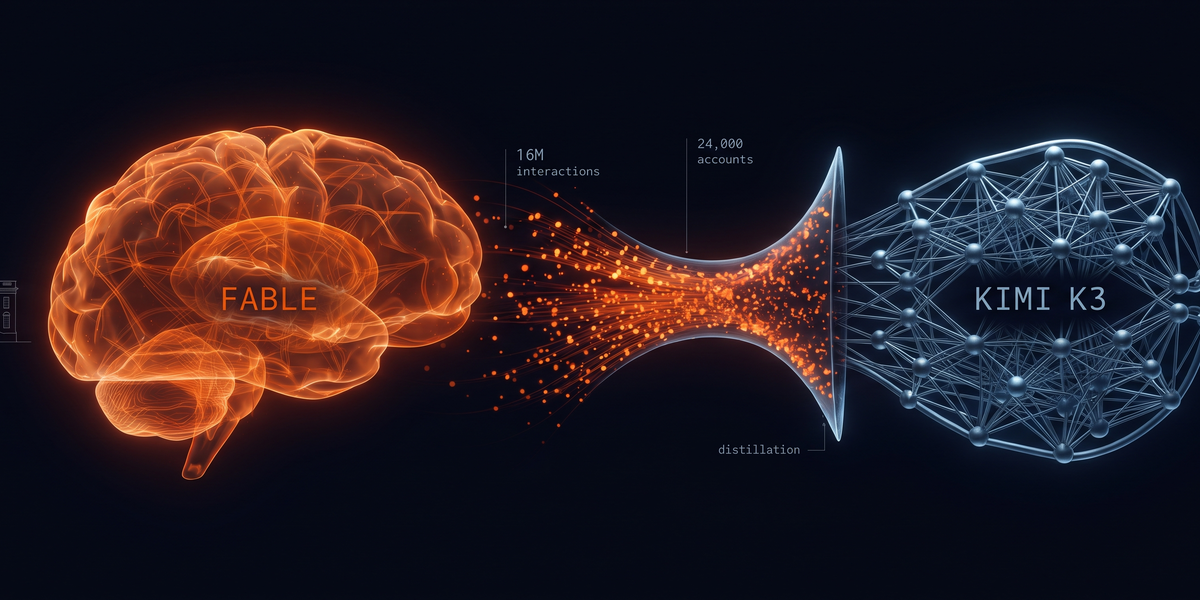
- Michael Kratsios, director of the White House Office of Science and Technology Policy, publicly accused Moonshot AI of distilling Anthropic's Fable model to build its K3 model on July 23, 2026. - Treasury Secretary Scott Bessent said he is considering adding Moonshot AI to a trade blacklist and imposing sanctions. - Moonshot AI allegedly built a "sophisticated internal platform" to conduct large-scale distillation while switching access methods to avoid detection. - Kimi K3's full open-weight release is scheduled for July 27, which American labs reportedly fear will make derived capabilities freely downloadable. - In February, Anthropic disclosed that three Chinese companies including Moonshot used roughly 24,000 fake accounts and generated over 16 million interactions with Claude.
The White House just leveled a direct accusation at a Chinese AI company that should make every developer paying for frontier API access stop and think. On July 23, 2026, Michael Kratsios, who leads the White House Office of Science and Technology Policy, posted on X that Moonshot AI distilled Anthropic's recently-released Fable model to develop its K3 model. He called it "large-scale, covert industrial distillation aimed at stealing proprietary U.S. technology and undermining American research." Treasury Secretary Scott Bessent followed with a separate X post saying he is considering sanctions and a trade blacklist designation.
This is one of the first times the U.S. government has publicly named a specific Chinese AI lab and a specific American model in an alleged intellectual property theft incident.
What Did the White House Actually Say About Moonshot AI?
Kratsios did not mince words.
His post on X stated plainly: "We have information that Moonshot AI distilled Anthropic's Fable for the development of its K3 model." He drew a careful distinction between what he considers acceptable practice and what crossed a line. Legitimate distillation, the process of training a smaller, cheaper model on the outputs of a larger, more expensive one, is what he called a "vital part of the open innovation ecosystem." The accusation centers on scale and secrecy.
The specific allegations are striking.
Kratsios claimed Moonshot built a "sophisticated internal platform" designed to run distillation at scale, one that could "quickly switch between multiple methods of access to avoid detection." He also said the company acquired servers containing Nvidia GB300 chips and used them in Thailand, "likely to train its AI models." That detail matters more than it sounds. It means the U.S. government is tracking Moonshot's hardware supply chain, not just monitoring API logs.
Here is the uncomfortable part. Kratsios presented no public technical evidence alongside the accusation. The Times of India noted that Fable was released roughly a week before K3 shipped, which has fueled genuine skepticism about whether there was enough time to conduct large-scale distillation, train a new model, and release it. The claim was stated with confidence. Proof was not part of the presentation.
How Widespread Is the Distillation Problem?
This accusation did not appear in a vacuum. In February, Anthropic disclosed that three Chinese AI companies used its Claude model to improperly obtain capabilities. The companies named were DeepSeek, Moonshot, and MiniMax. According to Reuters, they created roughly 24,000 fake accounts and generated more than 16 million interactions with Claude, violating Anthropic's terms of service and regional access restrictions. Sixteen million. That number should reframe how you think about "distillation" as some academic technique.
At that scale, it is industrial data extraction.
The U.S. State Department escalated the broader campaign in April with a diplomatic cable directing a global push to highlight what it described as widespread attempts by Chinese companies to steal intellectual property from U.S. AI labs. The cable included a warning worth quoting directly.
Models developed from "surreptitious, unauthorized distillation campaigns" enable foreign actors to release products that "appear to perform comparably on select benchmarks at a fraction of the cost but do not replicate the full performance of the original system."
Translation for anyone running a small business: the cheap model that benchmarks close to frontier might be a facsimile, not the real thing.
It scores well on the tests you can see. It may degrade on the edge cases you discover in production.
House committees launched their own inquiry in April into what they called "a pattern of conduct by [Chinese]-based AI laboratories" involving "large-scale theft of proprietary capabilities from American frontier AI systems through adversarial distillation." Piyush Sharma, CEO of Tuskira, an AI cybersecurity company, told CyberScoop that distillation lets developers capture many of a model's core capabilities. You are not copying weights. You are teaching a student model to imitate a teacher by feeding it millions of conversations. The clone walks and talks like the original.
Under the hood, the understanding is shallower.
Why Kimi K3's Open-Weight Release Changes the Calculus
Kimi K3 is the model at the center of this entire confrontation.
It is described as an open-weight model whose release "knocked tech stocks around last week." According to Moonshot's own performance claims, K3 scores on coding and general capability benchmarks at or above Anthropic and OpenAI frontier models. In Moonshot's own accounting, only Claude Fable 5 and GPT-5.6 rank higher overall.
But here is what actually worries American labs. Moonshot plans to release the full K3 model weights on July 27, free to download and modify. Four days from now. Once those weights are public, any capabilities derived from alleged distillation become globally available with no kill switch. You cannot recall open weights. Sanctions after publication close the barn door when the horse is already in a dozen countries.
My agency builds AI automation for small businesses.
When a client asks whether they should use a free open-weight model instead of paying API fees, the calculus just got harder. If Moonshot AI ends up on the Entity List, using K3 in U.S. commercial products could become legally problematic overnight. The model you integrated on Monday could be contraband by Friday.
If you are running K3 in production today, document the dependency. Identify what you would swap to. If you are evaluating it for a new project, the cost of waiting four days to see whether sanctions follow the weight release is negligible compared to the cost of building on a model that might get pulled from legitimate U.S. commerce.
The Skepticism Question Nobody Is Asking Loudly Enough
The timeline problem is real and nobody in the U.S. government has addressed it publicly.
Fable was released roughly a week before K3. Distillation at the scale Kratsios described, building a "sophisticated internal platform" that switches access methods to avoid detection, generating enough training data, fine-tuning, evaluating. And shipping a frontier-grade model in seven to ten days strains credulity for some observers.
This does not mean the accusation is false. Intelligence services have capabilities the public never sees. But the compression of that timeline has led reasonable people to ask whether Chinese labs might simply be getting better at this. If they are, crying theft is politically convenient. It is easier to allege IP theft than to admit the technology gap you assumed existed may have closed faster than expected.
My take: both things can be true. Moonshot may have distilled from Claude through fake accounts in February. That is documented by Anthropic itself.
The separate claim that K3 was specifically distilled from Fable in a one-week window is the one that needs more evidence than a government post on X.
What Should You Actually Do Right Now?
If you are building on K3 or any Moonshot model, the action items are concrete. First, map every place K3 touches your stack. Second, identify an alternative model at a similar capability tier that you could migrate to within 48 hours. Third, watch what happens on July 27 when the weights drop and what happens in the days following as Treasury decides on the Entity List question.
If you are not using K3 yet but were considering it, hold.
The next two weeks will tell you whether this model has a future in U.S. commercial deployment or whether it becomes a legal liability. Free weights are not free if using them exposes your business to sanctions risk.
The White House made its accusation.
Moonshot has not publicly responded. The weights drop Sunday. Pay attention.
Sources: CyberScoop | Yahoo/Reuters | Times of India
Comments ()