
xAI Burned $6.4B Last Year. Anthropic Is Paying $1.25B a Month to Keep It Running
TL;DR
- xAI lost $6.36B on $3.2B revenue in 2025. Losses quadrupled while revenue grew 22% - Anthropic pays xAI $1.25B/month for Colossus/Colossus II compute through May 2029. That's $15B in guaranteed revenue buried in the S-1 - SpaceX is effectively cross-subsidizing the entire AI bet — Starlink's $4.4B operating income funds a $30.8B annualized capex rate - Three AI IPOs in 6 months means API pricing windows are closing — OpenAI files this week, Anthropic targets Q3-Q4, and once public, every one faces margin pressure from Wall Street - Go multi-model now. Lock in current pricing before these companies answer to shareholders and raise rates
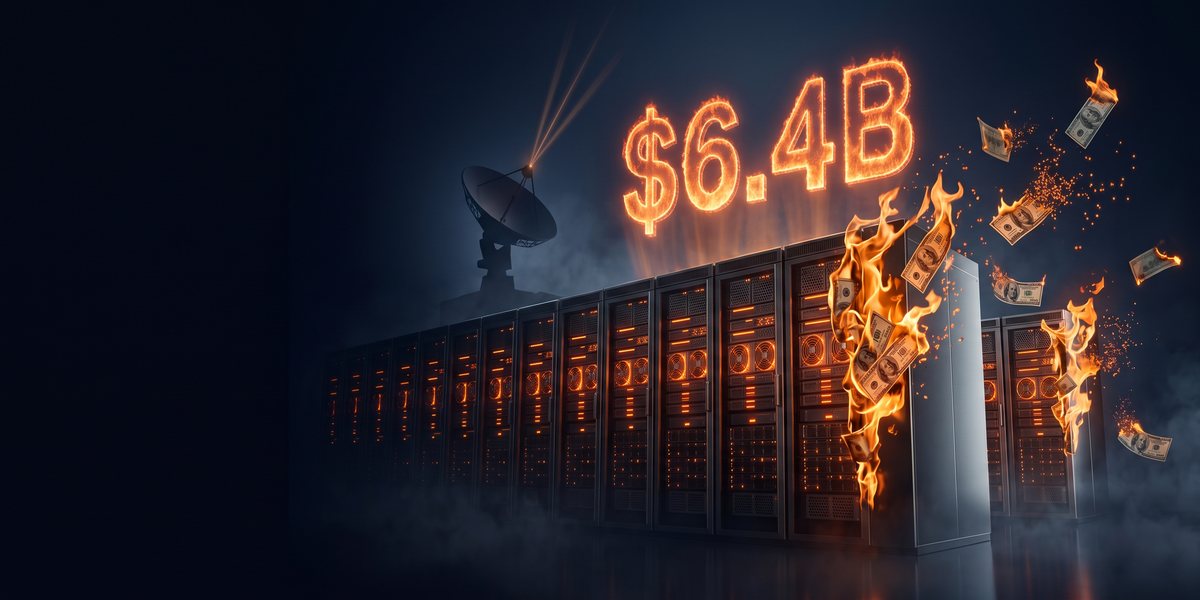
The S-1 dropped on May 20 and detonated across every major tech publication inside two hours. Two separate Hacker News front-page threads. PitchBook ran it twice. TechCrunch broke it clean. The numbers were stark: xAI lost $6.36B on $3.2B revenue in 2025. Losses quadrupled year-over-year.
Revenue grew 22%.
Q1 2026 makes it worse: $2.47B operating loss on $818M revenue, with $7.7B in AI capex in a single quarter.
Annualize that and you're looking at a $30.8B compute burn rate. SpaceX wants to raise up to $75B at a $1.75T valuation, roadshow starting around June 5, listing as SPCX on Nasdaq.
The Anthropic Deal Is the Real Story
Here's what's buried on page 147 of a 200-page filing that nobody is talking about.
Anthropic signed a contract to pay xAI $1.25B per month for access to the Colossus supercomputer cluster.
Through May 2029. That's $15B in guaranteed revenue over four years. Roughly half of xAI's projected 2026 topline.
The number two AI lab is writing $15B in checks to the number one AI challenger. That's not a vendor relationship. That's mutual assured dependency.
Why does Anthropic need xAI compute? The same reason everyone needs Nvidia GPU time. Supply: tight, the demand is vertical, and if you don't have compute you don't have a product. The deal lets Anthropic scale inference without building out Colossus II on its own balance sheet.
It lets xAI book guaranteed revenue against a build it was doing anyway.
This is what the AI economy looks like when you lift the hood: two companies burning cash to rent each other's hardware while investors wire them more money to keep doing it.
Your API Bill Is Subsidizing Someone Else's Data Center
Here's the part that matters for you.
Anthropic charges you for API access. xAI charges you for Grok. They are both losing money on every call. Anthropic lost $1.8B on $1.1B revenue in 2025. xAI lost $6.4B on $3.2B. They are not pricing rationally.
They are pricing for adoption, which means you are getting a discount that has nothing to do with what the service actually costs.
The moment these companies go public, that game changes.
OpenAI reportedly files this week for a September listing.
Anthropic targets Q3-Q4. SpaceX hits the road in June. Three AI mega-IPOs in half a year. When your CFO is a public market shareholder who wants margins, you stop burning to grow and start charging to survive.
You should expect API price hikes, feature gating behind enterprise tiers. And startup credit programs quietly sunsetting before the end of the year. Not because the companies want to be cruel.
As the math stops working once there's a quarterly earnings call.
The Multi-Model Play Is Not Optional Anymore
I run my agency on a mix of providers.
I've been telling clients for months that single-vendor lock-in is a bad bet when the entire market is still in burn mode. The S-1 confirms it. These companies are not pricing to profit. So any price you're seeing today is a temporary artifact of venture-backed subsidy.
Once they IPO, that subsidy ends. The discounts you're getting on GPT-5.4, Claude, Grok, Gemini. They're not permanent. They're a window that's closing.
Here's what I did on my own accounts last month: audited every API call, benchmarked the same task across three providers, moved the ones where quality difference was negligible to the cheaper option.
Switched one client's workflow from GPT-5.4 to Sonnet 4 for routine extraction work. Saved about $340/month on that account alone. The model difference in output quality for that specific task? Not noticeable.
That's the play. You don't have to go all-in on one provider. You have to build enough flexibility that you're not caught flat-footed when your favorite model gets 30% more expensive in Q4.
Starlink Is Paying for Grok
One more thing nobody is saying clearly.
Starlink has 10.3M subscribers and posted $4.4B in operating income in 2025.
That business is profitable. xAI is not. Musk is running one viable enterprise to finance another speculative one. And the S-1 makes that cross-subsidy visible for the first time.
The implication: if you were waiting for AI compute costs to drop since the infrastructure play would eventually commoditize. The Starlink numbers suggest the opposite. The profitable satellite business is being used to fund more compute investment, not less. The capex race isn't slowing down.
For small operators, this means one thing clearly: you cannot compete on infrastructure. You never could. The competitive layer is the application layer. What you build on top of the models, how you combine them, what workflow you own.
The compute will always be expensive somewhere, by someone, for reasons that have nothing to do with your business.
Build where you can win.
The Window Closes Before the Roadshow Starts
SpaceX roadshow begins around June 5. OpenAI files as early as this week. Anthropic follows in Q3-Q4.
Once those registrations are effective, every pricing decision goes through a CFO who answers to public shareholders.
The venture-scale discounts that got you here. Free tiers, startup credits, low per-token rates — are artifacts of a funding environment that stops when the IPO bell rings.
My advice: audit your API spend this week.
Lock in annual contracts where you have pricing guarantees. Move non-critical workloads to the cheapest capable model. Build your prompts to be model-agnostic so switching costs are low.
The money is artificially cheap right now. That never lasts.
Comments ()