
You Have Real AI Choices Now
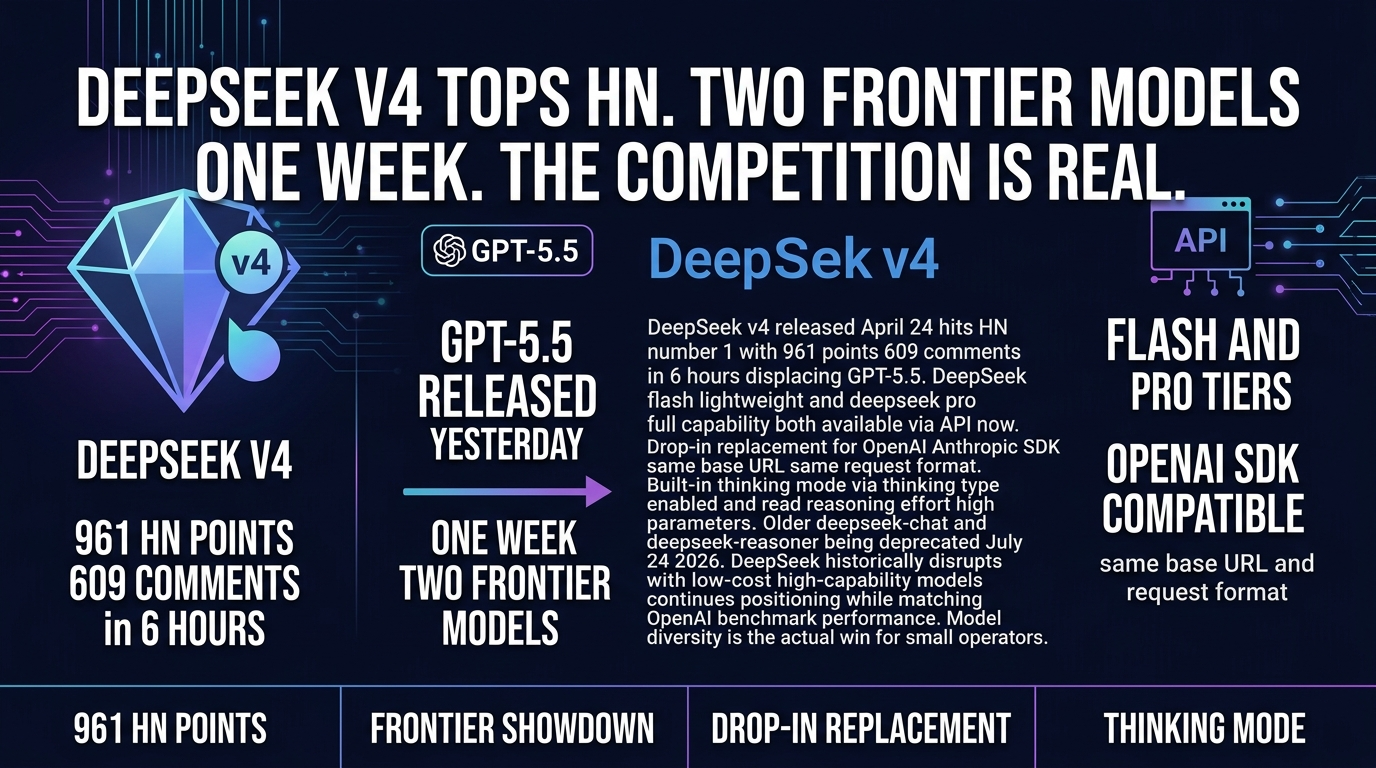
Two frontier model releases in the same week. DeepSeek v4 dropped on April 24, hot on the heels of GPT-5.5, and immediately hit #1 on HN with 961 points and 609 comments. The AI world has not seen this kind of same-week competition in a long time. For small operators and agencies, this changes the game more than any single model release would.
DeepSeek v4 comes in two API tiers. Flash for fast, lightweight work. Pro for full capability. Both available now. And here's the thing that matters for your stack: it's a drop-in OpenAI SDK replacement. Same base URL, same request format, same tooling. If you've been building on OpenAI or Anthropic, switching or dual-sourcing takes minutes.
The benchmark comparisons are coming in. The HN thread is split between people running their own evals and people arguing about cost. That split tells you something. The competition is real enough that people are doing actual work to compare instead of dismissing outright.
Why Model Diversity Is Your Actual Win
Model diversity isn't just a technical story. It's an economic story. When two frontier models release within days of each other, comparison shopping stops being theoretical. You can actually evaluate the cost-capability tradeoff without waiting six months for the next release cycle.
DeepSeek has a history of disrupting with low-cost, high-capability models. If they keep that positioning while matching OpenAI's benchmark performance, the price pressure on everything above them is real. That's good for your budget. That's good for your clients' budgets.
The agencies that figure out how to evaluate and switch between frontier models will have a cost advantage over the ones that pick one and commit. Not because the technology is changing, because the pricing is.
The OpenAI-Compatible API Is the Real Story
Here's the thing nobody is talking about enough.
DeepSeek made their API OpenAI-compatible by design. Same base URL, same request format, same SDK support. That's not an accident. That's a strategic move to make migration frictionless. They're saying, try us, it's easy to switch back if you don't like us.
For agencies building on AI automation, that frictionlessness is valuable optionality. When OpenAI changed their API terms last year, a lot of teams got burned because they'd hard-coded to a single provider with no exit ramp. The teams with dual-source setups survived. The ones who went all-in on one provider had to scramble.
This release is your reminder. Build abstractions. Keep exit ramps. Don't hard-code to a single provider even if the current one is cheaper or better. The difference between "I can switch in an hour" and "I need two weeks to migrate" is the difference between a minor inconvenience and a business continuity problem.
The Compliance Question Nobody Is Asking
Here's the uncomfortable part.
DeepSeek is a Chinese AI lab. That matters for data-sensitive work. If you're building client workflows that touch proprietary data, regulated data, or anything with compliance implications, the API call is going to a Chinese company's servers. That's not a technical question. That's a legal question.
The fact that DeepSeek keeps pushing low-cost models doesn't mean they've solved the compliance questions that matter to regulated industries. HIPAA, SOC 2, GDPR, financial services compliance. These don't disappear because the API pricing is good.
Before you add DeepSeek to your stack for production client work, know where your data is going. Know what the retention policies are. Know what your compliance obligations are. The API is open and the pricing is attractive. That doesn't make the compliance questions go away.
The real takeaway: you have real choices now. Two frontier models in the same week. Competition is good for you. But competition doesn't solve the basics. Know what you're building, know where your data goes, keep your exit ramps.
Sources: HN Discussion | DeepSeek API Docs
Comments ()